




Mining the Heart
Discipleship is far more about the inner life than we might imagine.
We’re in the middle of a meandering walk through the fields and forest of deep discipleship, and we’re waist-deep in what Dallas Willard referred to as “The Great Omission.” The modern church talks about making disciples, but struggles to actually form people who act, think, relate, and love more and more like Jesus.
This central focus of life in Jesus isn’t even on the radar of some Christian institutions.
Many churches assume their purpose is to produce converts and people who hold to a certain set of beliefs, not necessarily to help shape people who are less angry, more generous, shrewd in their relationships, and live lives that look strange if not bizarre to those around them.
A relative of mine just finished seminary at a well-respected school in the eastern U.S. While she received a top-notch Christian education, she also said her fellow students (future pastors) were among the most standoffish, aloof, and isolated people she had met. The school may be producing people who know Greek and Hebrew, but are they shaping people who love with radical abandon?
A simple overview of what most Christian institutions track and report reveals The Great Omission. “Prayers of salvation,” baptisms, church attendance, and weekly donations are standard. A few of those may be meaningful, but how about measuring flourishing marriages, reconciled friendships, acts of radical forgiveness, and the church’s influence on the other six mountains of culture in their community (business, education, government, the arts, media, and the family)?
Sometimes we “feel” The Great Omission. We sense a disconnection from God, others, and ourselves. We wonder if there is more to a relationship with God than what we’re experiencing. We wonder what this “abundant life” thing is all about.
On a larger scale, a lack of deep discipleship results in cultural and social decline (what happens when we don’t love our neighbors and ourselves well).
If you’re new and want to get caught up on our exploration so far, jump back to this post and move ahead at whatever pace suits you.
Going Deep
Richard Foster once said, “The desperate need today is not for a greater number of intelligent people, or gifted people, but for deep people.”
“Deep people,” as it turns out, aren’t necessarily the same as smart people, popular people, successful people, powerful people, church leadership people, or even respected people. Deep people tend to live and operate in layers of life that others ignore, avoid, or shun.
And deep people are keenly aware of the power and influence of ideas, a hidden world in which you and I have just begun to dabble here.
An idea is a conclusion, assumption, or principle in which our hearts are rooted, but of which we’re generally unaware. Ideas aren’t so much intellectual thoughts as they are “experienced realities.”
I’ve confessed that it takes a while to get into the habit of digging for and identifying ideas, but once we do, we become more “awake.” We become better attuned to the assumptions and desires that truly drive us and those around us. This enables us to love God, others, ourselves, and creation and culture better. We become more like Jesus.
We find ideas in two big categories: in the Air (culture) and in the Soil (our hearts).
For example, one of the most powerful ideas in Western culture today is “consent.” As long as two or more individuals agree to some behavior, that act becomes sanctioned, if not sacred. We find the idea of “consent” hidden in all seven mountains of culture, most notably in the arts, media, and government. We don’t really think about consent anymore – it’s the air we breathe. Though consent is not a universal idea, nor has it been predominant in all cultures and times (other cultures have assumed conclusions that prioritize what is best for the family or a society, rather than the individual).
Digging for ideas in our hearts (the Soil) can be tricky because we’re really good liars, particularly to ourselves. Looking into our hearts is best done with God and a trusted friend or two.
I once met a self-proclaimed evangelist who shared her version of the Gospel with anyone who would listen (and many who wouldn’t). She tracked “decisions for Jesus” carefully and was quick to share her statistics. Meanwhile, she couldn’t control her spending, struggled with substance abuse, and bounced from relationship to relationship. Her heart was governed by dark ideas about her value, purpose, and love, though she was oblivious to her soul sickness.
And that’s worth exploring – the difference between our belief statements and the authentic conditions of our hearts. Because, as it turns out, Jesus is more concerned with the genuine state of our hearts than He is with our surface statements of faith.
Heartview
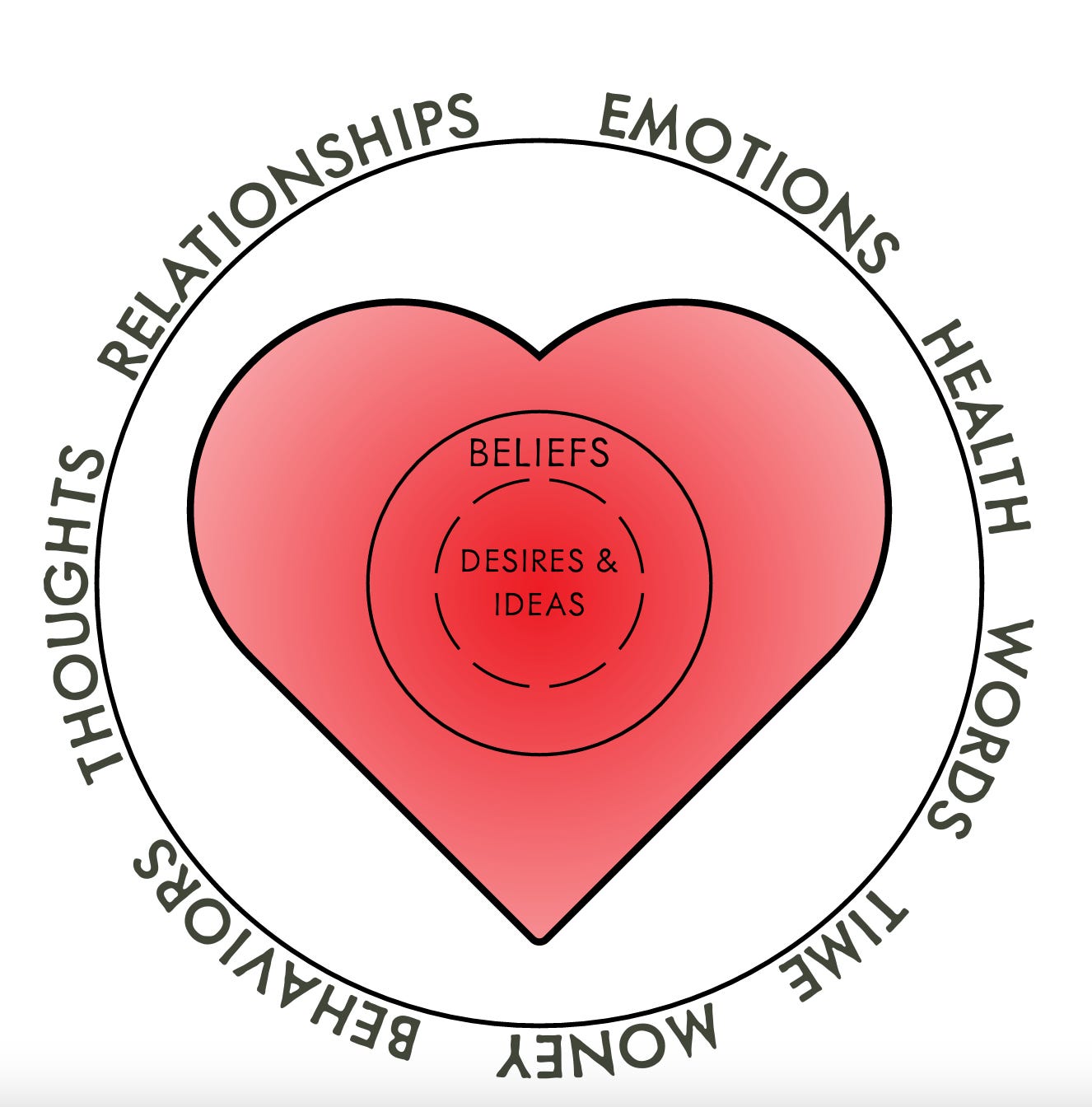
I’m obviously not a graphic designer, but the picture below provides a ridiculously simplified way of viewing the heart in relation to the human person.
(You can find this image as a PDF here (Heartview Ep 17) if you wish to download it.)
As we explored in the last post, our hearts are complex, often hidden, and act as if they have minds of their own at times. Yet the Bible invites us to explore them, draw them out, guard them, and become increasingly attuned to them (i.e., Prov 4:23).
At the very bedrock of our hearts, we find ideas and desires (the experienced realities that drive us and the people and things for which we truly long). Ideas and desires sit underneath our beliefs, though note the dotted, porous line. Ideas, desires, and beliefs mix and mingle with each other. Sometimes they align, and sometimes they don’t.
A dis-integrated person is someone who believes one thing, but whose heart is governed by ideas and desires that don’t align with his beliefs. An integrated person is someone whose beliefs and ideas are usually the same. We are all disintegrated to some degree, though the deeper the disciple, the greater the integration.
Deconstruction
The term “deconstruction” has become en vogue as of late, and it usually refers to someone who is experiencing the destruction (and sometimes rebuilding) of their belief system.
A friend of mine was telling me about a former missionary in their family who has deconstructed. She left the faith after years of laboring to spread the Gospel. She had seen so much pain and suffering that she concluded that there was no God, or that He wasn’t good after all. She determined the Bible was not authoritative or historically reliable.
Certainly, she is experiencing the Wall (which we explored here). Facing a difficult crisis, her formerly rock-solid belief system is giving way, and she is coming face to face with her deeper, authentic ideas and desires. Whether she is conscious of it or not, she is experiencing her heart’s disintegration – her ideas of God are different than her beliefs about God.
I strongly suspect her newfound critique of the authority of Scripture is not the issue. Rather, her hidden ideas about God have been shaken and broken by her very real, painful experiences. She’s angry with Him. Though Jesus is inviting her to join Him in beautifully and carefully reshaping her ideas and desires so that she awakens further to Him, she has decided that her ideas about God are truer and safer. At least for now.
Still, I suspect Jesus would rather we express and explore our hearts’ authentic ideas with Him rather than pay lip service to belief statements. This former, deconstructed missionary may be closer to Him than thousands sitting in churches.
How Do We Explore Our Ideas?
So if the world needs people of depth, and deeper people are those who are attuned to the ideas that govern their hearts and the hearts of others, how do we mine for these hidden ideas?
Sigh. The path to breaking through our surface belief statements and discovering our true ideas and desires almost always runs through the Wall. Meaning, that we don’t normally plumb the depths of our hearts unless our hearts are shaken and torn by some sort of crisis or tragedy. Rare is the person who courageously shovels through the layers of the heart to uncover their ideas without some painful earthquake of a reason.
I was sitting with a pastor friend recently, and he asked me what was the most spiritually formative element in my life. Being a lifelong Protestant, I suppose my “correct” answer should have been the Bible. But I responded, “Suffering.” He didn’t seem to know what to do with my answer, though, as Hannah Hurnard suggested, some Truth can’t just be read. It needs to be experienced.
I’ve not met very many deep people in my life, though I admit I may not be wise enough to recognize them when I do. But those I have met and am aware of all share one thing in common – they have experienced tremendous suffering. And, amid their suffering, they made a choice. At some point, perhaps after being graciously worn down through their pain, they chose to plumb the depths of their hearts and the heart of Jesus. Their attempts to numb or escape the pain were unsuccessful, and they surrendered to the call we all receive when we suffer: to press into it. To wrestle with it. To question it.
This is why discipleship is far more than learning verses and going to Bible studies. Are those things formative? They often are. But the life of a deep disciple is one in which we join in the life of Jesus. We experience some of what He experienced, including His sufferings. And through these difficult times, we begin to see the dark and light ideas that He saw. And we accept His invitation to join Him in His Idea Revolution, a revolution that transforms every aspect of human life, even when that transformation sometimes comes through trial.
I don’t like to suffer. I hope you don’t either. Though the journey into the depths of the human heart is often a series of choices we face when we encounter the inevitable, heart-shaking Walls.
And, as we’ll explore down the road, it’s a journey best taken with others.
Duc In Altum!
Brian