

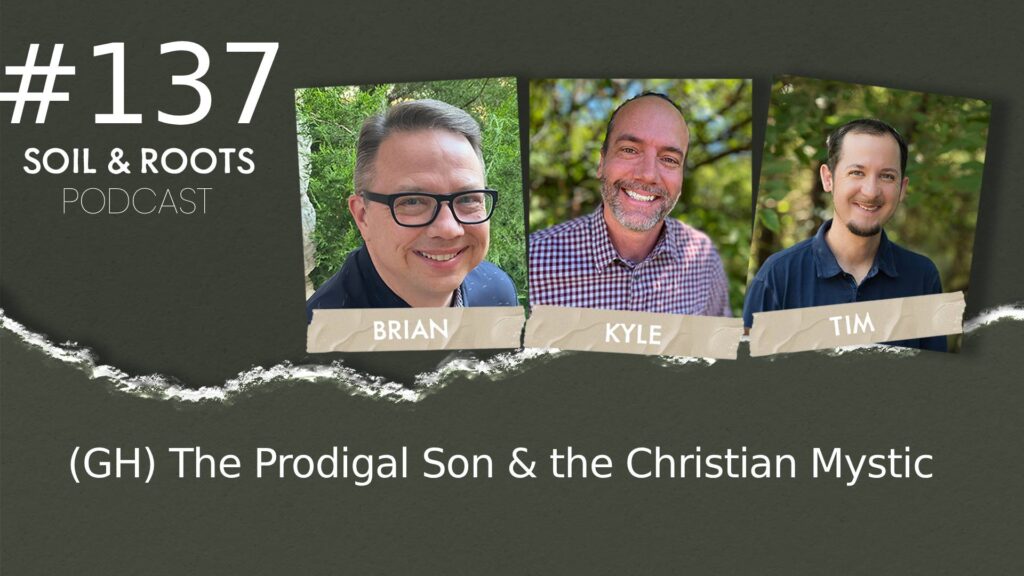



As children, we take trusting God and others for granted. Then we grow up, and that trust is shattered in a million different ways. We cope with breaches of trust by intellectualizing and trying to take control, usually without even realizing it. It only makes sense – we want to protect our hearts from further hurt and harm.
In this autobiographical episode, Brian shares some of his story and how returning to a childlike trust always involves turning inward for a while. And it involves some deconstruction – the breaking down of parts of ourselves that we once thought were good, but are obstacles to freedom and authenticity in the Kingdom.
TRANSCRIPTION
Deconstruction and Discipleship
For Jessica and me, our careers and family life haven’t always turned out the way we originally thought.
I joke that I’m a “recovering corporate executive.”
I was recruited into the financial services sector in my twenties and really enjoyed most of my time there, and eventually spent some wonderful years in the media and marketing worlds.
Half of my career has been spent leading a few different Christian non-profits, and the other half in the for-profit world.
I’ve been a company of one, and I’ve managed as many as 175 people. I’ve attempted to start a few things from scratch, and I’ve stewarded budgets as high as $38M. I’ve never done the big-box-company thing, but I’ve found a sweet spot in small- to mid-sized organizations.
Our family has experienced some very high highs and some very low lows. I’ve enjoyed some corporate success, and I’ve also had my share of failures. I’ve made some great decisions and some terrible ones.
I’ve worked with some amazing people, and I’ve worked with some duplicitous and underhanded people – most of whom claim to follow Jesus. There were times when I treated people compassionately, fairly, and kindly, and sometimes when I didn’t. There were times when I was treated compassionately, fairly, and kindly, and times when I wasn’t.
I’m supposedly in the middle of my peak earning years, but that certainly isn’t my present reality. Most of the career dreams and aspirations I had in my twenties have evaporated. To some extent, that’s a good thing.
When I was a younger man, I imagined I’d help change the world through music, then through business, then through Christian ministry. I worked long, hard hours on this Christianized version of the American dream. I bought into it, and I sold it.
There’s always a darker side to wanting to change the world, and we’ve experienced the dingy shadows of institutions, others, and ourselves along the way.
Most of my career was spent in workplaces where Christianity was accepted, if not promoted. I’ve worked with some amazing, wonderful people.
However, after a while, with some skepticism, I realized there wasn’t much difference between a Christian and a non-Christian, at least in the environments I worked in or even created. There were just as many affairs, schemes, deceptions, and power struggles in the “Christian” organizations I served as compared to the ones that didn’t carry the label. It didn’t really matter if it was a church, a Christian non-profit, a media company, or a financial firm.
It’s been difficult not to become cynical. Some days I lose that battle.
Family and Friends
When we’re newly married and dreaming about a family, we tend to function from a set of assumptions and expectations about how life is going to go.
We’re going to have a boy and a girl! And they’re going to grow up with loads of friends, both be valedictorians, star in school plays, excel at sports, and go on to become doctors or lawyers!
Well, we have two boys, young men now. Hopefully, we’ll have a girl in our family tree down the road.
Our oldest loathed high school and went straight into the workforce after graduation. Our youngest tried college for a year, and it wasn’t for him either.
Yet they now live together with some great friends in a rented house, follow and love Jesus, have formed a community of like-hearted guys, and are figuring out this whole adulting thing. They live 10 minutes away, and we see them pretty often, especially when Jessica cooks. I’m so proud of the men they’re becoming, even if their path doesn’t look much like what I originally thought it should.
Our marriage turned out better than we expected. It’s not that we had expected it to fail. It’s had its ups and downs like anyone else, but the depth and breadth of what we’ve experienced together has been far beyond what we even knew existed back when we said, “I do.”
Growing up, I figured I’d form some friendships in high school and college that would last for the rest of my life. How many TV shows feature lifelong friendships that stand the test of time?
At least for me, these types of friendships have been elusive. Moving to three different states hasn’t helped, though most of my friendships seem to have been built on the convenience of being at work or church together. If those environments changed, so did the friendships. I suspect I’m just a victim of the transient nature of our society and perhaps a general shallowness caused by our crazy schedules, though I confess I’ve often wondered if there’s just something fundamentally wrong with me.
Church
My first church experience came when I was six years old, and I started my spiritual journey in a small Missouri Synod Lutheran church in Pennsylvania. Lots of liturgy, high church music, symbolism, and structure. Our family later moved to a Methodist church that later became charismatic. That’s an interesting story. My late teen years were spent in a large Assemblies of God congregation.
I went to college in western Pennsylvania, met Jessica, and we attended a mainline Presbyterian church for our time there, primarily because it was across the street from campus and we were too tired and lazy to drive anywhere else.
After Jess and I were married, we settled in Pittsburgh and attended a popular non-denominational Bible church for about a decade that desperately wanted to become a multi-site mega-church. In that effort, they were successful. But it was there that I first started to question the role and impact of the institutional church, especially one so intent on generating lots of exciting but impersonal numbers.
It had all the allure of the popular seeker-friendly Willow Creek model, yet struggled with the power, money, and control issues that inevitably come with building a large system. I couldn’t put words to it at the time, but I think I began to wonder if that type of model was more about the industry of Christianity versus the heart of it.
I was a church musician for many years, so I participated in concerts and services in just about every type of context you may imagine: catholic mass, all of the mainline denominations, highly liturgical events, Black Baptist marathon services, services with pipe organs, and services with women running around barefoot waving flags while others were slain in the spirit. I haven’t seen everything in modern Christianity, but I’ve seen a lot.
In 2006, we moved to Ft. Lauderdale, Florida. I was hired to run a large international media non-profit. The ministry was associated with another large church, in fact, one of the first mega-churches in American history. The founder died a year into my tenure, and the power vacuum caused by his death sent most of the ecosystem into a tailspin, drastically shrinking the ministry and almost destroying the church.
A few years later, we moved to Texas and helped to plant a small church in the Dallas area. We spent a decade there, yet my angst about the role and purpose of the modern church remained.
Eventually, we moved to a supposedly non-denominational church that desperately tries to hide the fact that it’s Baptist, but it’s Baptist. We were there for several years and realized, probably too late, that although we had served and gotten involved, we had developed no real friendships, and the church was having little to no impact on our spiritual formation. Senior leadership desperately wants their institution to be a mega church, and it looks like they’re succeeding. They evaluate how God is moving solely based on the number of conversions and baptisms they generate, numbers shared virtually every week from the pulpit.
So here we sit, in our early 50’s, as new empty-nesters, in an area that has a church on every corner, with no idea what to do or where to go.
This isn’t how I thought things would end up.
Nieuwhof and Comer
A friend sent me a YouTube video of Carey Nieuwhof interviewing a writer named John Mark Comer. Nieuwhof has built a pretty large social media platform where he visits and chats with key Christian leaders.
Comer is one of the up-and-coming “it” speakers and writers in the spiritual formation movement. He’s a former megachurch pastor who has done a whole lot more thinking about the modern church than I have. I’ve linked to their conversation on the blog if you want to watch it. [1]
Comer reminds me of another popular Christian writer and speaker – Lisa TerKeurst. They’re both brutally, if not uncomfortably, transparent and vulnerable in their books and public appearances.
Growing up in an age of spotless, perfected Christian evangelists and speakers on TV, these two sometimes feel like welcome breaths of fresh air, if for no other reason than I can relate to their faults and failures better than the perfectly timed jokes and polished bullet points of typical Christian media.
They talk openly about their faults, their sins, their bad decisions, their wounds, their therapists, and their current joys. They paint a picture of their world as it is, rather than how we feel pressured to make it seem.
There’s a section of the conversation between Nieuwhof and Comer called, “Why church is underwhelming.” That pretty much sums up where I am, so I watched the video with some interest.
Comer ties his comments to the six stages of spiritual formation that we’ve explored in some detail here from the book The Critical Journey. Apparently, we’re all reading the same stuff.
This is a theory and not something to be taken as Gospel truth. It’s just a way to envision our journey into deep discipleship. It’s not perfect, nor is it prescriptive.
Stage 1: Awareness of God
Stage 2: Learning about Him
Stage 3: The productive life
Stage 4: The Journey Inward (and the Wall)
Stage 5: The Journey Outward
Stage 6: A life of love
We’ve mentioned before that the modern church may be very helpful and intentional about guiding us into the first three stages. But in most cases, that’s where the journey stops.
Here’s the good news: for those in the first three stages, the modern church is wonderful. It’s educational, inspirational, and instructional. It’s formative.
Here’s the bad news: for those who hit stage 4 and the Wall, the modern church provides little to no help, guidance, support, or community. In fact, it may contribute to some sort of deconstruction in the hearts of those facing the Wall.
Deconstruction
This word, “deconstruction,” has become popular over the past few years, though it means different things to different people. Jon Bloom does a nice job tracing the history and usage of the word, and I’ve linked to his article on the blog.
To some, it means leaving a faith system altogether. If someone claims they have “deconstructed” from Christianity, it means they no longer hold to the normal set of Christian beliefs, nor do they follow Jesus. Several high-profile celebrity Christian pastors, musicians, and speakers have completely left the faith over the past several years.
Sometimes people deconstruct from a theological system, such as Reformed theology or dispensationalism. They remain Christian, but they leave a certain approach to reading and interpreting the Bible.
To others, it simply means the breaking down of some formerly held truths or assumptions in the hopes that whatever is “reconstructed” is a better mousetrap.
I’m summarizing, but here’s what Comer talks about in the interview about deconstruction and the modern church.
In most church settings, the first three phases look like this: we evangelize and introduce people to God, we educate them about God, and then we invite them into leadership (a small group leader, a missions trip coordinator, an elder, a deacon, etc.). That’s where the work and vision of most churches stop.
Comer comments bluntly that, for people who’ve been sitting in churches for years and have heard the same sermon series a dozen times, church is simply boring.
Now the legalists will immediately jump up and claim that “we don’t go to church to be served, but to serve! It’s not about what we get from it but what we put into it!”
Ok, those people can pipe down because legalists have no concept of the Inward Journey or the Wall, otherwise they wouldn’t be legalists.
At the point where we consciously or unconsciously conclude that the modern church institution no longer guides us or helps us on our journey, what do we do?
And what if that conclusion comes at a time when we’re facing a Wall? A theological crisis? A death? A broken dream or desire? An unmet expectation of God, others, or ourselves?
Chances are, something in our hearts starts to deconstruct.
Out of guilt or a sense of responsibility, we may continue on the same path at church, even while our hearts steadily sink into doubt, listlessness, or despair. We become the embodiment of the “rule-follower.” We go through the motions because that’s what good Christians do, even while we fall farther and farther from the “abundant life” the Bible so ardently promises.
Maybe we can change churches or try a different model. We move from a mega-church to a home church or vice versa. Or we change denominations.
Or, in some cases, our hearts conclude that the doubts, confusions, isolation, and loneliness caused by the Wall won’t be healed or resolved, at least not in church, and we give up on the faith altogether.
We go find some community – any community – that reignites our passion for life and people. In other words, we head back to the energy and fire of stage 1, just in another ecosystem, including ones that bear little resemblance to our original communities of faith. Our new communities may even be opposed to our original Christian communities.
Most of this happens unconsciously, and it rarely has to do with our surface belief systems.
But some type of deconstruction happens in hearts all the time, especially in our disconnected age. It’s happening in my heart right now.
Good Deconstruction?
Stage 4 and the Wall have been my home for a few years now. Candidly, I don’t want to be here. I’ve bounced off it a few times earlier in my life, and I’ve successfully avoided it and fled back to Stage 3. Stage 3 feels safe, primarily because ignorance is bliss.
There’s a risk of getting stuck in Stage 4. The Journey Inward is necessary, and we often come back to it over and over, but it’s not the place to make a permanent home.
The Wall and the Inward Journey involve some sort of deconstruction. In my case, it’s brought up new doubts and questions about myself, my relationships, and the role and purpose of modern church institutions.
If the church is well equipped and excellent at guiding some through Stages 1-3, that’s fantastic. But what about the rest of us? And by the rest of us, I mean all of us, who eventually come up against the Wall?
On this podcast, I’ve openly questioned the assumption that a half-hour weekly sermon is the primary formative event of the week. That is, without question, the underlying idea of modern Protestantism. It’s woven into the fabric and culture of our churches.
That was my assumption for a few decades. It no longer is. I’m fairly certain a weekly sermon is wonderful for someone in stages 1-3, but provides little to no formation for someone in later stages.
What about the assumption that gathering together for an hour a week with strangers or people we probably won’t have much contact with the rest of the week somehow qualifies as what Hebrews 10:23-25 is referring to? Is that the type of “community” the writer assumed when he penned those words? I no longer think so.
On and off for years, I read and studied the opposing views of baptism – infant or adult. Here’s what I concluded. I no longer care. I care very much about baptism, but I find the debate no longer worth having.
Modern worship music or hymns? I’m comfortable with either. Let’s move on.
The late Tim Keller was a supporter of what he referred to as a city-wide Christian ecosystem. Every major city needs a few mega-churches, lots of mid-sized and small churches, parachurch organizations, and other Christian efforts.
Having spent about half of my life so far in mega-churches or churches attempting to become that, I can’t agree with him. I’ve deconstructed mega churches, particularly as I’ve studied and taught on deep discipleship, which requires extraordinary attention to the individual, something the mega church can’t possibly value more than its need for growth and the engine necessary to support its expensive operations.
Who am I?
I don’t know which stage of your journey you’re in, and this isn’t a race.
If you’re working your way through the first few stages, and your church is central and important to your family and your spiritual formation, that’s fantastic. And I mean that. You’re exactly where you should be, and you’re in great hands.
That’s not where I am, and my guess is that’s not where a lot of people are.
Maybe it just comes with the angst of being middle-aged and all the changes that come with it. We’re new empty-nesters. Our career lives have been anything but predictable. My body continues to disappoint me. We’re unsure what to do about the church. Thank God for our Greenhouse.
Life isn’t simple. The Christian life certainly isn’t simple. Anyone who tells you otherwise is just selling something, even if it’s wrapped up in Christianese.
I know far less now than I did when I was 25. I’m far less certain of things now than I was when I was 25.
Part of this mysterious journey inward involves asking ourselves who God really is, and who we really are.
As a lifelong Christian and church attender, as an executive who led and ran non-profit and for-profit organizations, as a husband to the best friend I could ever ask for, as a father to two young men being spiritually formed, who am I?
I am a man slowly, so slowly, being formed into someone who doesn’t need to know everything and doesn’t need to control everything.
Who am I? I’m Eustace Scrubb.
Eustace Scrubb
Eustace is the cousin of Lucy and Edmund Pevensie and finds himself on a mystical, transformative journey with them aboard the Dawn Treader, a ship belonging to King Caspian in the land of Narnia.
He’s an impertinent and selfish young man, and he uses manipulation and arrogance to control the world around him to his benefit.
At one point on the journey, Eustace wanders off alone on an island, only to discover the dark cave of a dead dragon. Inside, he finds all manner of treasure, including a wonderful bracelet which he slips loosely onto his arm, only to then fall into a deep sleep.
Hours later, he awakens to discover that he has transformed into a dragon himself, and the loose-fitting bracelet now digs painfully into his much bigger limb. He is beyond miserable, as he slowly realizes his fate.
As you might imagine, his cousins and fellow travelers initially view him as a great danger and fear his presence. But Eustace is eventually able to convince him that he, the dragon, is actually their ill-tempered and controlling companion.
They come to accept him, and Eustace the dragon begins his new life as a beast on the outside, while his heart begins a different kind of transformation.
One night a strange and fearful lion comes to him and Eustace has the sense that he should start undressing – meaning he should try to peel his dragon scales from his body. He does just that, but his efforts are not nearly enough to shed his armor-like plating.
Let’s let Eustace continue the story. “Then the lion said – but I don’t know if it spoke – ‘You will have to let me undress you.’ I was afraid of his claws, I can tell you, but I was pretty nearly desperate now. So I just lay flat down on my back to let him do it. The very first tear he made was so deep that I thought it had gone right into my heart. And when he began pulling the skin off, it hurt worse than anything I’ve ever felt. The only thing that made me able to bear it was just the pleasure of feeling the stuff peel off. You know – if you’ve ever picked the scab of a sore place. It hurts like billy-oh but it is such fun to see it coming away.
Well, he peeled the beastly stuff right off…and there it was lying on the grass only ever so much thicker, and darker, and more knobblying-looking than the others had been. And there was I as smooth and soft as a peeled switch and smaller than I had been. Then he caught hold of me – I didn’t much like that for I was very tender underneath now that I’d no skin on – and threw me into the water. It smarted like anything but only for a moment. After that it became perfectly delicious and as soon as I started swimming and splashing I found that all the pain had gone from my arm. And then I saw why. I’d turned into a boy again.”[2]
One of the points John Mark Comer makes is that, as we grow into deeper discipleship, Jesus forms us at deeper levels. When we first choose to follow Him, perhaps we’re convicted of swearing or not giving enough at church. When we’ve walked with Him for a long time, and we allow Him into the deeper strata of our hearts, He digs into our genuine desires, our deeper sins, and our hidden and unconscious ideas.
He starts to peel away at our need to know more than is good for us.
He starts to peel away at our frenetic pace, perhaps by allowing illness or physical impairment.
He starts to peel away at our hidden ideas of performance, perhaps by allowing us to wander in the wilderness for far longer than we’d like. To be placed in environments where our performance is irrelevant.
He starts to peel away at our desperate need for control, perhaps by taking away those things we cling to for control, even if we’re not consciously aware of them. Perhaps by leaving us powerless.
So, who am I? I’m Eustace Scrubb. I’m still mostly dragon, but a small part boy. Aslan is peeling away at my scales, and in truth, it hurts like hell. His paws, if we allow Him, do cut to the bedrock of our hearts. But there are moments, and hopefully more and more of them, where the pleasure of being descaled, of being undressed, of deconstructing in the best sense of the word, provides the foundation of genuine hope amidst the pain, anxiety, and tension of being stripped of our dark ideas, our corrupted desires, and our constant need for control.
What strikes me about our story is that, after Eustace had suffered for so long as a dragon with his bracelet mercilessly digging into his arm, he accepted the painful descaling without question. He simply lay down, surrendered, and allowed Aslan to cut into his heart.
So, yes, I’m Eustace Scrubb. And still, I’d like to become more and more like him.
[1] https://www.youtube.com/watch?v=qrVKA0_CyJc&t=2s
[2] Lewis, C.S. (1980). The Voyage of the Dawn Treader, (pp. 99-115, various excerpts). HarperTrophy.