



Suffering is a universal human experience, yet it raises perhaps the most difficult questions for Christians. Why does a good God allow so much pain and suffering?
And, as we grow to become more like Jesus, can a deep disciple learn how to suffer “well”? What does that even mean?
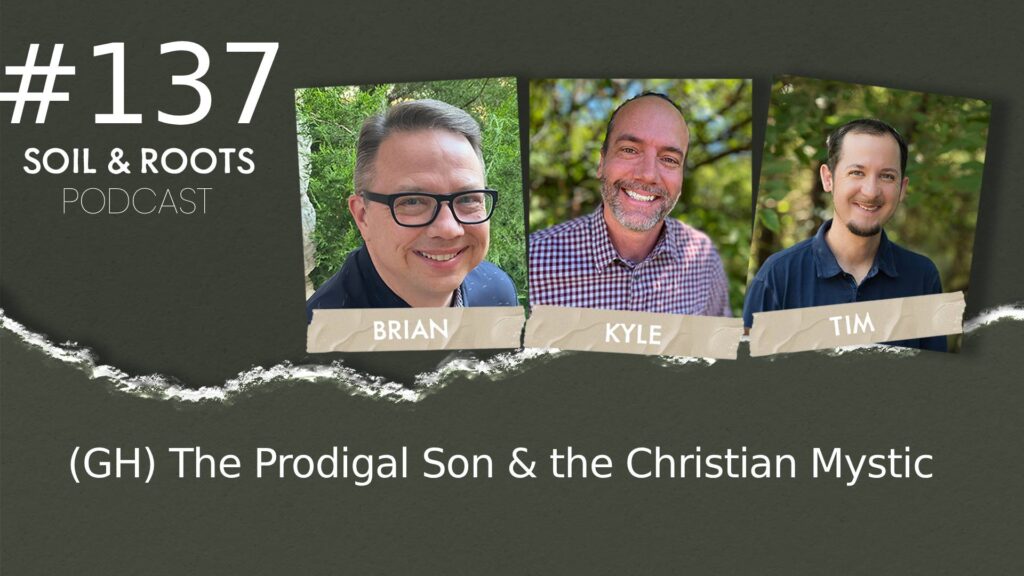
Join Brian as he explores the reality and challenge of suffering.
TRANSCRIPTION
Suffering Well
As you probably know, Soil & Roots is not just a podcast, it’s a non-profit ministry that helps to cultivate deep discipleship.
So, what is “deep discipleship”? You can find a short e-book on our website called “What in the World is Deep Discipleship?” if you want to read up on it.
Though we’ve answered the question from a few different perspectives over the last two years here.
- Theologian Dallas Willard examined the modern church and concluded we’re suffering from “The Great Omission.” Though we may be teaching good Biblical doctrine and making some converts, we’re not intentionally or deliberately focused on helping people become more like Jesus. That we think like Jesus thinks, act like He acts, relate like He relates, and love like He loves.
Most churches and, frankly, most modern Christian communities don’t see themselves as “character-forming” institutions. Most of the time, a church, a small group, or a Bible study views itself as teaching “right doctrine” or maybe making converts. That’s great…though it may or may not be formative.
As we’ve explored, instruction is only one of the five key elements of formation. Lots of people know great doctrine yet remain stuck in their spiritual formation.
Many people aren’t aware of this Great Omission, though we may feel it. We may quietly wonder, “Is this all there is to the Christian life?” Or we may have this nagging sense of disconnection from God, others, and even ourselves.
So deep discipleship is the internal, often challenging character-forming part of our spiritual journey.
- We also looked at The Critical Journey, a book that proposes our discipleship journey can be described in six stages. The modern church excels at guiding us through the first three: Being introduced to God, learning more about Him, and entering a life of productive service.
However, very few of us ever receive any help or guidance on the last three stages: the Journey Inward and the Wall, the Journey Outward, and the Life of Love.
So, deep discipleship may be described as the intentional progression through all six stages, particularly the last three. Unfortunately, the modern church experience may not be much help here.
- Another way to describe deep discipleship is the exploration of these hidden, often unconscious ideas that govern and power who we are. This may be the weirdest description of deep discipleship, primarily because it suggests there’s a level of the human heart underneath our belief statements that remains largely unexplored. Plus, we don’t recall seeing the word “idea” described like this in the Bible.
Of the three ways we’ve explored deep discipleship so far, the concept of exploring Jesus’ ideas and our own takes a while to get our arms around. But it’s pretty life-changing once we begin to explore the hidden depths of our hearts.
McJesus
Deep discipleship stands apart from the modern-day “McJesus” or “Meme Christianity.”
As an example, just this morning I was trolling online and came across a meme by a preacher who apparently said, “I want to tell you something, and I want to make it very, very clear. Don’t listen to your heart. Listen to the Bible, the Word of God.”
On the surface, doesn’t that sound great? So committed to Christianity? So simple? So McJesus? Don’t trust your heart; your heart is all jacked up. Just trust your Bible.
Let’s go a bit deeper.
Is there only one Word of God? Meaning, does that phrase only apply to your Bible? Obviously not, since the Bible itself refers to the Word in various ways. The Bible claims that Jesus is the Word. The Word isn’t just a book, He’s a person.
The Bible refers to God’s creative power as His Word. He spoke the universe into existence through His Word. The Word isn’t just a book and a person – it’s also an awe-inspiring, creative force.
So, the Holy Spirit is considered the Word of God. For followers of Jesus, where exactly does the Holy Spirit reside? Oh yeah, in our hearts. So… we never listen to or trust our hearts, the place where the Word of God makes His home?
So, deep discipleship goes beyond Meme Christianity and McJesus, toward the more curious, richer soils of the faith.
The Problem of Pain
We’re exploring the Forgotten Kingdom – the fact that the primary theme of the New Testament is the kingdom of God, yet if you line up ten Christians and ask them what the “Gospel of the Kingdom” means, chances are you’ll get seven or eight different answers. That’s a real problem.
And we’re rounding the corner on this mini-series here in Season 4. We’re exploring a few perhaps hidden qualities of a Kingdom Dweller, of a deep disciple, and today we’re going to explore what it means to suffer “well.” We have one more quality after that, and then we’ll move on with the season.
Some segments of our discipleship journey involve doubt, suffering, pain, trial, confusion, and disconnection. They seem integral to our spiritual formation, even though they raise many questions and challenges.
If you’ve ever sat down and spoken with an atheist or someone who’s “deconstructed,” someone who once followed Jesus and no longer does, chances are their rejection of the faith is tied to a primary question that has haunted us for centuries: “Why does a supposedly good God permit suffering and pain? Why is evil allowed to persist and inflict so much harm on us? Why does He allow us to inflict so much harm on ourselves and others?”
A friend was telling me recently about a former missionary who, because she had seen so much addiction, trauma, abuse, and hopelessness on the mission field, came home, rejected Christ, and now angrily defends agnosticism.
Church leaders and pastors are struggling. 70% of pastors fight depression, and 50% of them are so discouraged that they would leave the ministry if they could. But they feel trapped and believe they have no other way to make a living. 50% of new ministers won’t last the first five years. And although 4,000 churches will spring up this year, 7,000 of them will close.[1]
Suffering, pain, anxiety, and depression are real. I know some people believe that, since we follow Jesus, we should never experience anxiety and depression and, if we do, something’s wrong with us. Well, then, something was wrong with Charles Spurgeon, C.S. Lewis, Martin Luther, John Bunyan, and Mother Teresa.[2]
But how does a deep disciple deal with suffering and pain…well? What do we mean by that? And is that even something we should aspire to?
For my part, I deal with suffering and pain poorly. The last several years have been difficult for our family in several ways, and I’d love to tell you I’ve woken up every morning, praising God for the sunshine, and going about my day in joyful bliss despite our difficulties. That’s not usually the way it goes.
When I suffer, I complain. To God, to Jessica, to my friends, and to anyone who might listen. And I can become pretty selfish.
Not that we want suffering or welcome it. We’re not masochists. Yet when we run across deep disciples, to a one, they’ll tell you that spiritual formation, this journey to become more like Jesus, takes us through days, months, and perhaps years of suffering.
We’ve been discussing and debating this topic here at Soil & Roots because… well… at the moment, every family involved in the ministry is going through some form of hardship. Every family in our Greenhouse is going through some trials. It hasn’t always been that way, but it is at the moment.
I’m beginning to think this is more normal than abnormal.
And in my research, I came across a book in my library that I suspect many of you have read, C.S. Lewis’s The Problem of Pain. The copy I have was published in 1962. The pages are yellowed, and it has the marvelous old-book smell. I don’t know how it came to be in my collection, but someone highlighted passages in it before me with a barely visible yellow marker. However, I was somewhat comforted to find myself highlighting the same passages the previous owner had.
Not only did Lewis struggle with depression, as I have at times, but he also shared my approach to suffering. “You would like to know how I behave when I am experiencing pain, not writing books about it. You need not guess, for I will tell you; I am a great coward.”[3]
Lewis maintained that if God was going to create a world in which His crowning achievement had free will, suffering, and pain, they would be part of the human experience. But that doesn’t mean that suffering is good, per se.
Lewis asked, “But if suffering is good, ought it not to be pursued rather than avoided? I answer that suffering is not good in itself. What is good in any painful experience is, for the sufferer, his submission to the will of God, and, for the spectators, the compassion aroused and the acts of mercy to which it leads.”[4]
“Thomas Aquinas said of suffering, as Aristotle had said of shame, that it was a thing not good in itself, but a thing which might have a certain goodness in particular circumstances.”[5]
In what is probably one of Lewis’ most famous quotes, he cites how God often uses pain, despite its harm, for our goodness, “But pain insists upon being attended to. God whispers to us in our pleasures, speaks in our conscience, but shouts in our pains: it is His megaphone to rouse a deaf world.”[6]
High Places
So, suffering and pain aren’t “good” in and of themselves – they’re a result of our free will, whether we inflict suffering on ourselves, or others inflict it on us, or it’s just a result of living in a world in constant tension between the two kingdoms.
Yet God can use it for goodness. Here we naturally gravitate to Romans 8:28, where we’re assured that God causes all things to work together for good.
I think this verse is quoted too often. Just like I think we sometimes move too quickly to figure out what God might be teaching us and what lesson we should be learning when we’re in the middle of suffering.
To ask “why” while suffering is a valid human response. Most of us ask it. Job did. Even Jesus asked why God had forsaken Him on the cross.
When someone is in the middle of a crisis, dealing with the death of someone close to them, a divorce, a past abortion decision, an illness, a mental health crisis, a job loss, or an unwanted relocation, I’m not sure we should run in and try to provide explanations, even if we’re just trying to help.
Would answers even help in those moments? What if God did provide us with His explanation, and we didn’t like His reasoning?
Two books have impacted me deeply on the subject of pain and suffering. One is The Miraculous Life of Edward Tulane, and the other is Hinds Feet on High Places. Both are allegorical stories about characters who embark on long spiritual formation journeys.
Edward Tulane is a toy china rabbit given to a little girl in the 1930s. The main character in Hinds Feet is a little, deformed girl appropriately named Much Afraid.
Whereas Edward starts his journey as a vain, pompous toy, Much Afraid begins hers as just that – terrified and abused.
What is striking and, frankly, hard to read in both books is the sheer amount of suffering they both endure. By the time you finish reading Edward Tulane’s journey, you want to throw the book down and yell, “Seriously – he had to spend a lifetime in constant rejection, loneliness, and loss just to soften?”
Much Afraid becomes more afraid when her guide introduces her to her two traveling companions for her adventure: Suffering and Sorrow.
She fears them, finds them harsh and dangerous, yet as she progresses along her journey, she learns to trust and rely on them. By the end of her journey, Much Afraid gets a new name, as do her companions, Suffering and Sorrow. They become Joy and Peace.
Near the end of her journey, the little girl Much Afraid comes to grips with how truth often settles into our souls. And it isn’t simply a matter of being told what truth is.
“She began to understand quite clearly that truth cannot be understood from books alone or by any written words, but only by personal growth and development in understanding, and that things written even in the Book of Books can be astonishingly misunderstood while one still lives on the low levels of spiritual experience…”[7]
That begs a few questions. Are we living on the “low levels of spiritual experience?” Have we made our home there and intentionally avoided challenge, suffering, and trial because we’re comfortable in our ignorance?
In our very human attempts to shortcut our sufferings, numb our pain, and move through grief as fast as we can, are we instead stunting our journey into the deeper pools of discipleship?
If Much Afraid is right – in that we can’t ingest and understand some truths by simply knowing the right Bible verse or reading the correct commentary, that some truths need to be experienced, are we allowing ourselves those experiences? Again, not in some masochistic way of inviting suffering, but journeying through it well when it inevitably comes?
On Suffering Well
And still, how do we suffer well? How do we become like Paul with his tormenting thorn in the flesh? How do we rejoice, even boast in our sufferings? Is that even possible for those of us not named Paul?
If suffering and pain aren’t inherently good, and yet God still causes it to turn out for good, even if we can’t see it, even if we never know why, what does it mean to suffer well?
Two primary words come to mind: authenticity and community. To suffer well means to suffer authentically and with others.
Suffer Authentically
There seems to be a fair amount of pressure in some Christian communities to downplay, excuse, or shrug off our suffering.
Look, we’ve probably all known people who are constant complainers. They’re always the victim, always suffering, and generally pretty loud about it. They can be hard to be around because their sufferings have become fused with their identity.
I’m not talking about those people. I’m talking about the Christian couple I heard about last week who surprised virtually everyone in their world by splitting up. Obviously, the marriage had been suffering yet no one in their circle knew about it. Their church didn’t know it, and neither did their small group.
Or the person with a chronic illness who struggles to get through the day, but when asked about his condition, provides his stock reply, “I’m blessed.” He refuses most offers of help or even a listening ear because he believes that suffering authentically would imply he’s a complainer, and that automatically means he must be sinning.
You get the idea. Many followers of Jesus suffer in silence, spiritually, emotionally, and physically, because their hearts hold to the idea, the assumption, that that is what a “good Christian” does. We suffer in silence. We don’t want to put anyone else out, we don’t want to complain, we don’t want to be the center of attention.
Or we’re just prideful. We see suffering as a sign of weakness, and we don’t want to be perceived as weak. We have a desperate need to be seen as a put-together, mature Christian, someone to be looked up to, and if we communicate our suffering, we may lose our image and status.
Well, suffering indicates that we’re weak. I suppose that’s part of the point.
There’s a difference between suffering authentically and being a chronic complainer. There’s a difference between acknowledging our physical, mental, and emotional pain and asking for help and comfort versus using our suffering as some sort of attention-getter or power play.
We’ve talked about lamenting on the podcast before. Someone in pain is invited to express the depth, impact, and difficulty of pain through lament. Maybe it’s a lament in a journal, maybe to a spouse, a Greenhouse, a friend, or a family member. We are free to express our suffering in any number of ways and to express it as it truly is.
And we learn how to lament, to express the depth and width of our pain, though in a way that still embodies hope. If we’re not sure how to lament, Psalm 13 is a great place to start.
A deep disciple learns, over time, how to rejoice in their sufferings, in their weaknesses. They take time to rest, to lament, to contemplate.
Suffering in Community
Secondly, a deep disciple suffers in community. They allow their hearts to be open to others, they willingly share their story, and they invite trusted friends into their suffering with them.
Being truthful and authentic about our suffering and pain with ourselves is a great first step. Yet the story of our suffering is clarified, refined, and even transformed when we bring it to a trusted community and allow them to listen, learn, and participate in our pain.
Again, this takes a fair amount of humility. But suffering in loneliness is hell. Suffering in a trusted community is formative.
Soil & Roots helps form and support small, spiritually formative communities we call Greenhouses. Jessica and I are in one with six other people, all from different walks of life, different denominations, different perspectives. In our case, our Greenhouse is multi-ethnic, so as you might imagine, the stories and spiritual journeys of each person are really diverse.
We’re learning to suffer with each other.
To be fair, if you were to catch any of us in our various churches, you would look at us and assume we have it all together. But under the surface, just this one Greenhouse is well acquainted with suffering: chronic illness, depression, concerns with children, career challenges, grief over lost loved ones, gnawing questions about God and the Bible, loss from betrayal and abandonment, church hurt, and pain and suffering caused by stories from much earlier in life.
Do we sit around and talk about pain each time we gather? No. But the Greenhouse rhythms are designed to make space for doubts, questions, stories, and struggles. So, over time, we’re learning how to enter into these struggles with each other.
Curt Thompson insists that sharing our suffering in community is the path towards developing perseverance and hope.
“…it suggests that we are to bring that sense – of our stories with all the suffering they hold – into vulnerable communities so that we can practice revealing all that we continue to grieve and do so repeatedly, no matter how long it takes…To persevere, then, is to practice, repeatedly, bringing your story of suffering into the presence of a vulnerable community that invites you to do so, and this process strengthens your capacity to persevere.”[8]
Wrap Up
To suffer well, if we can learn to do so, means we suffer authentically and in community. Though when we’re in pain, our inclination may be to cut ourselves off from others, “gut it out,” or simply respond with Christian euphemism because that’s what we think a “good Christian” should do, the Bible and our experience with Jesus present a different approach.
If, right now, you’re in the midst of a time of trial, pain, and tribulation, my prayer is that you express your suffering with truth and candor…to God, to someone close to you. And I pray that you already have a great community around you, or that you will find one that is open and willing to suffer with you. Because it’s through that community of suffering that we find the darkness and pain transformed into something better. And as we persevere through our suffering, we may well find ourselves deeper disciples.
[1] https://expastors.com/why-do-so-many-pastors-leave-the-ministry-the-facts-will-shock-you/
[2] “ChatGPT. “Famous Christians Who Struggled with Depression.” 19 Mar. 2024, OpenAI.
[3] Lewis, C.S. (1962). The Problem of Pain: How Human Suffering Raises Almost Intolerable Intellectual Problems, (p. 105). MacMillan Publishing.
[4] Lewis, C.S. (1962). The Problem of Pain, (p. 110). MacMillan Publishing.
[5] Lewis, C.S. (1962). The Problem of Pain, (p. 122). MacMillan Publishing.
[6]Lewis, C.S. (1962). The Problem of Pain, (p. 93). MacMillan Publishing.
[7] Hurnard, H. (1975). Hinds Feet on High Places, (p. 225). Tyndale.
[8] Thompson, C. (2023). The Deepest Place: Suffering and the Formation of Hope, (p. 110). Zondervan Books.