

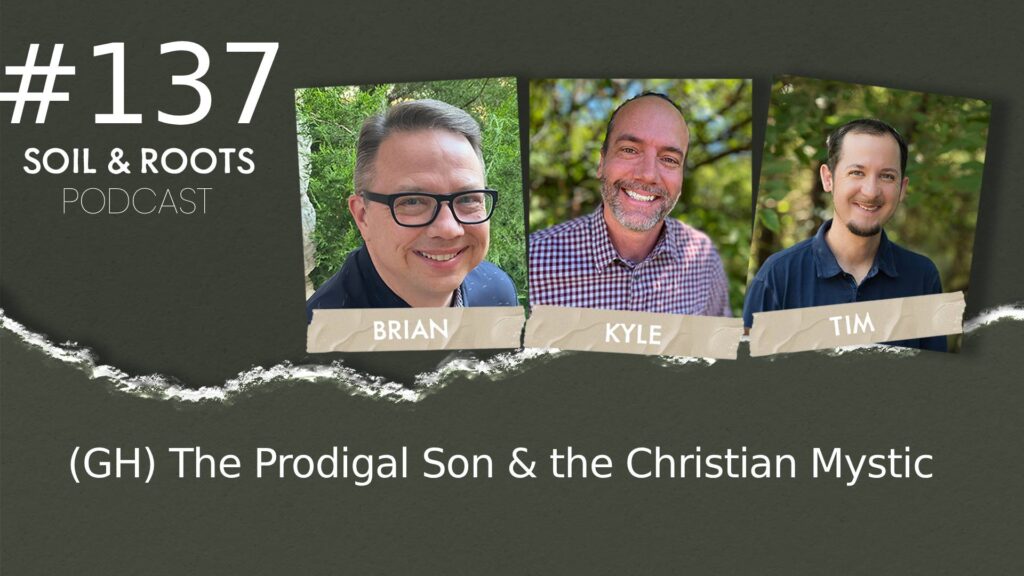


We ask for the kingdom to come every time we recite the Lord’s prayer. But in this episode, Brian asks a difficult question: Do we really want the kingdom to come? Perhaps the kingdom has been forgotten because we want to forget it in favor of deeper ideas and desires in our hearts. Let’s dig in!
TRANSCRIPTION
Thy Kingdom Come?
Sometimes people ask me how my wife, Jessica, and I first met. You’d think that would be an easy question to answer, but it depends on which of us you ask.
I first saw her across the room at a Christmas dance during my freshman year of college. I didn’t speak to her then because…well…I was there with someone else. A few weeks later, however, I ran into her in the campus chapel and introduced myself.
My recollection is she wasn’t impressed. She was a junior and had decided not to waste any time and effort on underclassmen. I was undeterred, however, and continued to find ways to providentially “run into her” at various campus functions. There was the evening I had a long conversation with her while playing board games. It was one of several positive interactions that I thought were over the coming weeks and months.
But they are interactions my wife doesn’t recollect. In fact, Jessica has no memory of me until about four months after the day I first saw her. And even at that, it took me a while to convince her to date me. We’ve been married for three decades, and most days I’m still chasing her around.
It does little for my male ego when my wife’s version of how we first met starts in a different year than mine. So much for first impressions.
What Is It Again?
The Forgotten Kingdom seems to work the same way. What it is depends on who you ask.
Kyle mentioned that he had previously thought the Kingdom was another word for heaven. And by heaven, he meant an ethereal plane where we sing hymns all day as disembodied spirits.
Many people assume the Kingdom of God is another term for the church – people throughout time who choose to follow Jesus. They believe the kingdom refers to a population.
Back in Episode 62, I mentioned that I asked ChatGPT what the Kingdom of God is, and it said the Kingdom “is a present spiritual reality that exists in the hearts and lives of believers. It is often described as the reign or rule of God in the lives of individuals who have accepted Jesus Christ as their Lord and Savior. It involves a personal relationship with God, transformation through the Holy Spirit, and living according to God’s principles and values.”
That definition is pretty popular, though it confines the kingdom to a spiritual reality and to the lives of certain individuals. That means, by contrast, that the Kingdom is not physical, and it does not involve the entirety of creation, culture, and populations.
So, is the kingdom simply a synonym for heaven? It seems that heaven is included in the idea of the kingdom, but that the kingdom is more than that, since Jesus insisted the Kingdom of God had arrived, and He was on earth when He made the claim.[1]
Is the Kingdom synonymous with the church, or with people who have decided to follow Jesus? Again, the enormous population of people throughout history is included in the Kingdom, but cannot be the entirety of the Kingdom.[2]
Is the Kingdom only a spiritual reality? Is the Kingdom only invisible, and does it only exist in the hearts of apprentices of Jesus?
That seems unlikely, given the number of times the New Testament claims that Jesus is king over both the heavens and the earth, the invisible and the visible.
Colossians 1 says:
For by Him all things were created, both in the heavens and on earth, visible and invisible, whether thrones or dominions or rulers or authorities—all things have been created through Him and for Him. He is before all things, and in Him all things hold together. [3]
Ephesians 1 tells us all things have been summed up in Christ, both things in heaven and things on earth. A few thoughts later, Paul says that Jesus is:
far above all rule and authority and power and dominion, and every name that is named, not only in this age but also in the one to come. And He put all things in subjection under His feet, and gave Him as head over all things to the church, which is His body, the fullness of Him who fills all in all. [4]
“Heaven,” “earth,” “visible,” “invisible,” “all things.” This doesn’t paint a picture of the kingdom as just a spiritual reality. It seems that Jesus is in charge of everything right now. Everything is in His kingdom.
Defining the Kingdom
At the beginning of the season, we began to toy with some definitions of the kingdom. Dr. Jeremy Treat came up with an eight-word version: “God’s reign through God’s people over God’s place.”[5]
I like it, though to me the word “reign” has a passive tone, and based on all that Jesus taught about the Kingdom, there isn’t much of that.
I’ve mentioned that the book that got me started on this whole Soil and Roots adventure is called Renovation of the Heart by Dallas Willard. He was a theologian, philosopher, and professor at USC and is considered one of the fathers of the modern spiritual formation movement.
He wrote:
The kingdom of God is the range of God’s effective will, where what God wants done is done. It is, like God, from everlasting to everlasting. The planet Earth and its immediate surroundings seem to be the only place in creation where God permits his will not to be done. Therefore, we pray, “Thy kingdom come, thy will be done, on earth as it is in heaven,” and hope for the time when that kingdom will be completely fulfilled, even here on earth, where in fact it is already present and available to those who seek it with their hearts.[6]
So, the Kingdom is heaven, but it’s also here on earth. It is spiritual, but it’s also physical. The church isn’t the kingdom, though the church exists in the kingdom and joins with Jesus to increase His kingdom.
Our mission here at Soil and Roots is deep discipleship, spiritual formation, character formation, and digging into our hearts to uncover the hidden ideas that drive us. So, is this grandiose, all-encompassing kingdom important to our spiritual formation, our journey to be formed more into the likeness of its king?
Willard wrote, “If we are concerned about our own spiritual formation or that of others, the vision of the kingdom is the place we must start. Remember, it is the place where Jesus started. It was the gospel he preached. He came announcing, manifesting, and teaching the availability and nature of the kingdom of the heavens.”[7]
So…if we desire to become deep disciples, people who intentionally join with God and others in the journey of ongoing character formation, the kingdom is where we focus first.
Our Ideas about the Kingdom
Yet, we’ve apparently forgotten the kingdom. If we were to line up 10 people from our churches or our Christian communities and ask them what the kingdom is, chances are we’d get 10 different responses.
How did we get here? If our modern-day version of the Gospel of Salvation centers around the forgiveness of sins, yet the Gospel of the Kingdom is the proclamation of God’s restorative reign over the cosmos, where in history or culture did we misplace the good news of this kingdom?
And have we forgotten our role, our purpose in it? My guess is that if you suggested to the same 10 people we just lined up that they are created by God as co-rulers of creation and culture, you’d get a lot of blank stares. If you asked them, “Did you know that you are crowned with glory and majesty, and you are commissioned by God to steward your piece of God’s kingdom as He restores the world to its rightful order?”, most wouldn’t know how to respond.
If the kingdom is so central to our faith, so primary to our formation, and so basic to our Christian education, what are our assumptions about it in an age that’s forgotten it?
If we quiet our minds and hearts and just marinate in the kingdom, do we assume it exists here on Earth? Do we assume it’s spiritual and physical? When we hear the word “Gospel,” do our hearts and minds immediately jump to the idea that the Good News is that Jesus came to restore and reconcile everything, all four of our relationships?
When we pray the Lord’s prayer, is this what we’re praying for? That God’s effective will continues to increase and multiply on the earth as He reclaims what’s rightfully His? When we read passages about Jesus sitting on His throne, governing over all rulers, all powers, all authorities, in heaven and earth, both visible and invisible, do we find ourselves truly operating from that reality?
If the modern church is confused about the good news of the kingdom, that suggests we may be confused about its king.
Who is the King?
Who is this King?
He’s the new Adam. Adam succumbed to the beast’s trickery; Jesus crushed the beast with His heel.[8]
He’s the new Enoch. Enoch walked with God and didn’t know death. Jesus walked with God and conquered death.[9]
He’s the new Noah. Noah climbed into the ark to save a few. Jesus climbed Golgotha to save the world.[10]
He’s the new Abraham. Abraham left his home and started a nation. Jesus left His home and started a worldwide multi-ethnic community revolution.[11]
He’s the new Isaac. Issac was “the miraculous child, offered as a sacrifice out of obedience to God, and rescued from death when all seemed lost.[12] Jesus was the miraculous child who offered Himself as a sacrifice out of obedience to God and rescued us from death when all seemed lost.
He’s the new Jacob. Jacob saw heaven opened, received the promises, and commissioned his twelve sons to bless the nations.[13] Jesus saw the heavens opened, received His Father’s blessing[14], and commissioned His twelve followers to change the world.
He’s the new Joseph. Joseph was a shepherd, loved by his father, hated by his brothers, unjustly accused, and later ascended to the right hand of Pharoah. Jesus is the Great Shepherd, loved by His Father, hated by his brothers, unjustly accused, and now sits at the right hand of the Ancient of Days.[15]
He’s the new Moses. Moses ascended the mountain, received the law, and led Israel out of physical bondage. Jesus ascended the mountain to teach and fulfill the law and led people of all nations out of bondage to sin.[16]
He’s the new Joshua. Joshua led Israel into the land God promised them. Jesus leads us into the city which has foundations, whose architect and builder is God.[17]
He’s the new Jonah. Jonah spent three days in the belly of a fish and still complained about God’s mercy and forgiveness. Jesus spent three days in the belly of the earth to lavish us with mercy and forgiveness.
He’s the new David. David, the giant slayer, united the kingdom of Israel. Jesus, the Satan-slayer, rules and unites the kingdoms of the earth.[18]
He’s the new Israel. Israel, because of its disobedience, wandered in the wilderness for 40 years. Jesus, in obedience, withstood the enemy after 40 days in the wilderness.
Jesus is the new humanity. Unlike every ruler, authority, power, governor, or king before Him, Jesus fulfills the true humanity God desired for us from the beginning.[19]
Jesus is the new creation. Adam’s actions wrought decay and disintegration in our relationships with God, others, ourselves, and creation and culture. Jesus’ actions bring restoration and reconciliation to our relationships with God, others, ourselves, and creation and culture.[20]
Who is Jesus, our King? He’s the Lion of Judah, the Lamb of God, the Arm of the Lord. He’s the Alpha and the Omega, the beginning and the end. He’s the Beginning of the Creation of God, the Captain of our Salvation, the Creator, the Cornerstone. He’s the head of the church, the heir of all things, the very image of God. He’s the Mighty One, the Morning Star, the Prince of Peace, the Prince of Kings, the only true Rock, the Son of the Highest, the True Light, the Truth, the Witness, the Word.
He is the King of the Jews, and He’s the King of Kings, the King of the Saints, the King of the Ages. [21]
This is King Jesus. Is this the idea, the assumption, the concept of our King that sits in the bedrock of our hearts?
The King’s Kingdom
If His kingdom is “God’s reign through God’s people over God’s place” and the “range of God’s effective will, where what He wants to be done gets done,” what does that sort of kingdom look like in our lives as we go about our day with our families and our businesses?
There’s a good chance that if we’ve forgotten the Kingdom, we struggle to form a vision of what life in the Kingdom is supposed to be like. And life in the kingdom is what the rest of this season will explore.
It’s been called the “upside-down” kingdom for good reason. The kingdom of light doesn’t function the way we naturally function. It seems like most of the assumptions about who we are, what we are, how we’re to act, what we’re to do, how we’re to relate, and what we’re to value get all jumbled when we start exploring the depths of the kingdom.
At least that’s what’s been happening to me.
This brings me to a question that has surfaced in my heart very recently. It’s been sitting in the background for months, but I haven’t let it come to mind until the past few weeks.
Here’s the question: what if I don’t want the kingdom to come?
I mouth the prayer asking that it come; my belief statement says I’m to seek the kingdom first. But what if the ideas in my heart tell a different story? What if I actually don’t desire that the kingdom come?
And what if I’m not alone? What if a primary reason we’ve “forgotten the kingdom” is because, deep down, we want to forget the kingdom? What if the modern church isn’t proclaiming the Gospel of the Kingdom not because it’s lost it or doesn’t understand it – but because it doesn’t want to?
It’s not that the kingdom is hard to find. It’s alluded to in numerous places in the Old Testament and is littered throughout the New. We say the word “kingdom” in our Christian circles all the time, even if we aren’t quite sure what it means.
What if the reconciliation of all things through Christ is a message we don’t want to proclaim?
The Unwanted Kingdom?
Why in the world would I not want the kingdom to come?
We surely want the benefits of the kingdom: racial and family reconciliation, precious unity among followers, overcoming injustice, peace with nature, confronting and defeating evil, fixing what’s broken and providing what’s missing, stewarding creation and culture the way God intended. Believing and operating as if the ideas of light are greater than the ideas of darkness. Believing that the ideas of light are the “deeper magic.”
These are all marvelous, wonderful things.
It’s not the benefits of the kingdom that make me wonder. It’s the cost of the kingdom.
Stage 6
I’ve talked about the six stages of spiritual formation here several times. They’re from a book called The Critical Journey. The book isn’t a deep theological treatise. If you’re a biblically orthodox Christian, you’ll find the book pretty centrist. I value the book because it suggests a framework of our discipleship that I can easily understand, and I think makes some sense.
Stage 1: Being introduced to God
Stage 2: Learning more about Him
Stage 3: A life of service
As we’ve discussed before, modern Christianity has these first three stages nailed down. If we’ve spent any time in a church, we easily recognize them.
The last three, however, are not nearly as familiar to us.
Stage 4: The journey inward
Stage 5: The journey outward
Stage 6: A life of love
We’ve talked about Stage 4 quite a bit – it’s embedded in the Discipleship Dilemma. We can’t grow to become more like Jesus without deepening our understanding of our own hearts.
Though let’s explore this Stage 6 a bit more, because it seems like someone in this last stage of spiritual maturity surely must have a good idea of how to live in the kingdom.
Here’s the book’s description of someone living in Stage 6, a life of love.
“When we are at stage 6, we have lost ourselves in the equation, and at the same time, we have truly found ourselves. We are selfless. This factor allows us to do the most extraordinary things. We may figuratively wash other people’s feet or give our very lives in the service of God (at times that means we die to self; at times it has meant and can mean that we die literally.)”
“Sometimes people at stage 3 (a life of service) are confused with those at stage 6 (a life of love). The people at stage 3, however, give to God what they can afford to give of time, talents, possessions, and money. People at stage 6 give more than they can afford; in fact, they give all they have without any sense that giving is in any way a sacrifice.”
“Even though it may be very difficult for others to understand us at this stage, people can be uplifted in spirit just by being with us, whether in joy or hardship. We can live openly and vulnerably with others because we do not need self-protection.”
“We have little ambition for being well known, rich, successful, noteworthy, goal-oriented, or ‘spiritual.’”[22]
How does someone in Stage 6 treat possessions? “We do not renounce material possessions. We simply learn to need them less; we become detached from things and people as props or bolstering devices…We travel light.”[23]
They go on, “We are full of surprises because we are so free, so full of God, and so whole. We can say or do preposterous things because we are not afraid of death.”[24]
I’ve read this description dozens of times and, I confess, it still seems foreign to me in many ways. Yet I’m drawn to it. Truth is, there are days when I desperately want to live this life of love, and there are days when the idea of it feels uncomfortable, impossible, and distant.
Radical if not outrageous generosity. Free to be who we are in Christ. Living openly and vulnerably. Little ambition for being well-known, well-off, goal-oriented, or even spiritual. Traveling light. Inclined to do preposterous things.
Who does that describe? Jesus, certainly. Daniel. Paul. Stephen? Mary, the sister of Lazarus?
Stage 6 describes someone who is earnestly praying that the Kingdom come, who is seeking the Kingdom first, even at extraordinary personal cost.
You Stand Over There
Now, let’s be honest – do our hearts truly desire that type of life? Or do we really want a life where we learn to love – but within polite and comfortable boundaries that we set?
For example, do we want to live a life of radical generosity, even if it might change our lifestyle?
I used to run a large Christian ministry and raised money for its cause, so I interacted with quite a few millionaires and even a couple of billionaires. Oh, the stories I could tell.
When I was a kid, I wanted to be wealthy, but now, having been around it enough, I’d rather not.
Some of the wealthy Christian donors I met were wonderful, genuine people. In many cases, however, the walls, institutions, protocols, standards, and layers of bureaucracy in place just to inquire of a wealthy Christian rival the DMV. These systems are put in place in the name of “biblical stewardship,” but in many cases, they’re just intended to keep people away.
Years ago, I was invited to give a presentation to wealthy Christian philanthropists at the Broadmoor, a fancy resort in Colorado. I was told to wait outside the building until I was to start speaking, and then I was immediately ushered out as soon as I finished. In other words, I wasn’t allowed to speak or interact with any of the wealthy Christians in the room.
I asked one of the workers why the speakers weren’t allowed to even say hello to our Christian brothers and sisters, and was told this was a “special time and place where the donors wouldn’t be bothered.” Granted, I’m white, but I hadn’t experienced such a bold expression of our class system in a while. I was living out James 2 in real life, having been told to “stand over there or sit down by my footstool.” I was glad I experienced it.
I’ve walked out of more than a few donor meetings, thanking God that He didn’t handle His grace the way that some of us handle our money.
We raised quite a bit of money over the years, though I don’t recall encountering a donor who had changed their lifestyle because of their generosity. I’m not against wealth, houses, planes, cars, and all of the toys and pleasures that money can bring. I just find it interesting that Jesus praised the destitute old woman who gave her last two cents…for the kingdom.
When I was a younger man, several of my Christian friends had their lives planned out. They were going to engage in some sort of high-profit business, make a lot of money, be generous to various causes, and then, in their 50s, retire comfortably. And then go and do “kingdom-centered” work, volunteering for their favorite Christian non-profits. I used to wonder what would happen if we happened to die before we hit 50.
What about some of these other characteristics of a Stage 6, kingdom-centered disciple?
Are we willing to drop our pretenses and our need for self-protection? Are we willing to lay down our strategic plans, our life goals, and our well-crafted financial targets if asked to do so? Would we even hear God if He asked us to do so?
Do we long to do preposterous things for God, things that seem odd, unconventional, and yes, even foolish, for the kingdom?
I think of Paul, who, because he was concerned for the famine-stricken people of Jerusalem, collected money from other churches and personally delivered it to Jerusalem – the very city where he knew a large number of people were looking to kill him. He was taken into custody, spending the rest of his life in prison, being bounced around to six mock trials, though still preaching and teaching the things of the Kingdom.
Which Gospel is Easier?
I suppose I tend to look at Paul, Mary, Stephen, Daniel, and others as “super-Christians,” people with unique, dramatic calls on their lives. In reality, positioning them like that just gives me an excuse not to aspire to be like them. They are in a “special class.” Isn’t it written somewhere else that we should go about our lives as is, in peace? Surely not everyone should expect to do preposterous things for God, right? Surely not everyone is on the path to living this life of love?
It’s a disturbing idea – that we may not want the kingdom to come and so we’ve willfully forgotten it, reduced it, changed it, and made it far more confusing and complex than it really is.
We’ve explored two versions of the Gospel in our culture right now: the Gospel of Salvation and the Gospel of the Kingdom. The Gospel of Salvation is the good news that Jesus died for my sins. Accepting that doesn’t seem very difficult. I say a prayer or decide to accept Jesus into my heart.
But the Gospel of the Kingdom? The good news that Jesus is the king of the universe, is reconciling all things to Himself, and is redeeming His creation from the kingdom of darkness? That He invites His disciples to participate in this “great reversal?”
That seems like a much bigger commitment. Maybe some suffering. Probably some pain. Most likely some sacrifices. Probably accepting and embracing some ways of doing things that, well, aren’t my ways of doing things.
If we have forgotten or reduced the kingdom on purpose, I suppose we can rightfully blame some of the problems on modern prosperity. We certainly hear various voices claiming that the kingdom grows faster and better in poorer parts of the world. But maybe it’s more than the size of our houses, our checkbooks, or our investment accounts. Those seem to me to be “above the surface” excuses.
Perhaps our willful “forgetting the kingdom” has more to do with deeply buried, hidden ideas on the bedrock of our hearts. Ideas about identity, security, control, power, desire, and love.
This description of a Stage 6 disciple – someone who places the kingdom first in their lives – doesn’t align all that well with what many of us assume a mature Christian should be. At least for me, I tend to picture the successful pastor with books and podcasts, or the wealthy Christian businesswoman who speaks at large church conferences.
But the description we’ve just explored suggests that John the Baptist is more in line with what we should expect. I don’t know about you, but I’m not really into locusts and honey. Well, I’m into honey, but you get my point.
This spiritually formative journey to become more like Jesus is usually slow; it’s highly relational. There’s little need to rush – it’s not that we’re trying to level up from Stage 3 to Stage 6 as quickly as we can, like we’re playing some video game. God is extraordinarily kind, patient, and gentle. If not curious.
So should we be. Kind, patient, gentle, and curious about ourselves and those with whom we journey.
Yet if we are going to pray truly and genuinely “Thy Kingdom Come,” if we truly desire to move towards living a life of love, that journey takes us into and through some very difficult places.
So, in a quiet moment of reflection, when we pray for the kingdom to come, let’s just ask ourselves, do we really want it to come? Not just its wonderful, beautiful benefits, but its struggle, heartache, and refining fire?
I don’t know about you, but when I meditate on that description of a person who lives a life of love, there are days when I long for it. On the days I don’t, I know I should. I want to want it if that makes any sense.
Some days I want to live in a place of radical generosity. I want to be free from my nagging desire for people’s approval and their praise and free from my unhealthy attachments. There are days when I want to love my enemies and do so joyfully. There are days when I want to pray for our daily bread and not worry or care about where tomorrow’s bread will come from. There are days when I wake up, set my mind and heart on God, and trust that whatever comes that day is from Him or allowed by Him, and rest in that reality.
And on the days I don’t want any of those things, well, I’m learning to just sit back and pray, “Thy Kingdom Come,” trusting that, even if I don’t mean it, it’s coming anyhow. And perhaps tomorrow I’ll embrace its advance with a better heart, a willing spirit, and a deeper trust.
Thanks for listening. Make sure to sign up for our weekly Soil and Roots email newsletter on the website. You’ll also receive a free short e-book called “What in the World is Deep Discipleship?”
[1] Matthew 4:17
[2] Colossians 1:13-20
[3] New American Standard Bible: 1995 update (Col 1:16–17). (1995). The Lockman Foundation.
[4] New American Standard Bible: 1995 update (Eph 1:21–23). (1995). The Lockman Foundation.
[5] https://www.thegospelcoalition.org/article/kingdom-god-8-words/#:~:text=More%20By%20Jeremy%20Treat&text=But%20if%20the%20theme%20of,the%20kingdom%20in%20eight%20words.
[6] Willard D. (2012). Renovation of the Heart: Putting on the Character of Christ (p. 86). NavPress.
[7] Willard D. (2012). Renovation of the Heart: Putting on the Character of Christ (p. 86). NavPress.
[8] Genesis 3:15
[9] Genesis 5:24
[10] https://www.thegospelcoalition.org/article/better-version-noahs-ark/
[11] https://www.christschurchblog.com/christs-church-blog/2018/8/22/jesus-and-genesis#:~:text=Jesus%20is%20the%20new%20Abraham,death%20when%20all%20seemed%20lost.
[12] https://www.christschurchblog.com/christs-church-blog/2018/8/22/jesus-and-genesis#:~:text=Jesus%20is%20the%20new%20Abraham,death%20when%20all%20seemed%20lost.
[13] https://www.christschurchblog.com/christs-church-blog/2018/8/22/jesus-and-genesis#:~:text=Jesus%20is%20the%20new%20Abraham,death%20when%20all%20seemed%20lost.
[14] Matthew 3:16-17
[15] https://reasonsforhopejesus.com/how-is-joseph-a-type-of-jesus/
[16] https://bibleproject.com/articles/sermon-mount-jesus-new-moses/
[17] https://www.ligonier.org/learn/devotionals/new-joshua
[18] https://jdgreear.com/jesus-is-the-true-and-better-david-you-arent/
[19] https://lectio.spu.edu/pauls-vision-of-new-creation/
[20] https://lectio.spu.edu/pauls-vision-of-new-creation/
[21] https://bibleresources.org/names-of-jesus/
[22] Hagbert, J. & Guelich, R. (2005). The Critical Journey: Stages in the Life of Faith, (pp. 152-153). Sheffield Publishing Company.
[23] Hagbert, J. & Guelich, R. (2005). The Critical Journey: Stages in the Life of Faith, (pp. 155-156). Sheffield Publishing Company.
[24] Ibid.