

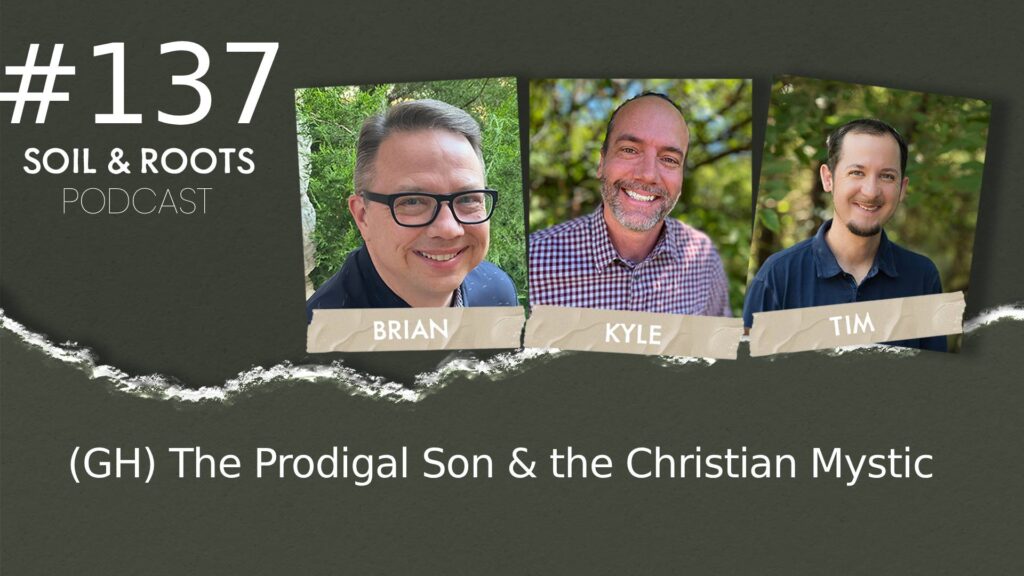


This is the first of two short bonus episodes exploring the Three Primary Problems that help explain why modern Christianity often struggles to make deep disciples.
In this episode, Brian Fisher revisits the foundation of Soil & Roots and explains how Dallas Willard’s idea of the Great Omission led to a deeper investigation of discipleship, spiritual formation, and the Kingdom of God.
TRANSCRIPTION
Three Primary Problems
This is the first of two short bonus episodes. One of the reasons Soil and Roots exists is what Dallas Willard called “The Great Omission,” that although modern Christianity talks a lot about making disciples, we’re actually struggling to make them. We explored the Great Omission in some depth in Season 1.
However, our journey to become more like Jesus is further challenged by Three Problems in our era. Season 2 was all about the Discipleship Dilemma; Season 3 is about the Formation Gap; and Season 4 will explore the Forgotten Kingdom. Those are the three problems.
Soil and Roots seeks to address the Great Omission by resolving the Three Primary Problems.
Because these seasons go pretty deep and it’s easy to get lost in the weeds, once in a while I like to remind us all why we’re here. So, these two bonus episodes are going in-depth into the Three Primary Problems.
If you feel like you have the Discipleship Dilemma, the Formation Gap, and the Forgotten Kingdom all squared away, feel free to skip these bonuses and move on to Episode 38, which begins our discovery of the key element of community.
A New Visual Aid!
Today, we’re releasing a new visual aid on the Soil and Roots website called the Three Primary Problems. You can find this new chart on the Resources page at soilandroots.org.
Over the next two episodes, we’ll walk through it together.
So, if you can, pull it up on your device or print it out before you continue listening.
How We Got Here
Let’s set the stage a bit.
I’ve been following Jesus since I was six years old, and I’ve been in church, studying the Bible, and involved in Christian service my entire life. But as I approached middle age, I began asking some difficult questions about my walk with Jesus.
Some of these questions arose from hitting that challenging Stage 4 of our spiritual journey – the Journey Inward – and the Wall, a crisis, problem, challenge, or trial that throws us for a loop.
And some of the questions arose from reading the theologian and philosopher Dallas Willard.
He claimed that most of us are unconsciously governed by hidden ideas and images. That our hearts are rooted in assumptions and concepts that most of us don’t realize or explore.
In essence, there is a layer of who we are, of our hearts, that sits beneath our belief statements and worldviews. There are mysteries and complexities to our hearts that, if explored, lead to greater human flourishing and a deeper Christian experience.
Though that sounded provocative and exciting, I didn’t particularly like the thought that I might be governed by things of which I wasn’t even conscious.
But it’s true, and many of these ideas are formed in our hearts when we were very young, when we were children.
I function based on assumptions that have developed over the years, and some of them align with my Christian beliefs, but some of them don’t. That realization was disconcerting to say the least. Some of my ideas belong to the kingdom of light, but some belong to the kingdom of darkness.
So, Willard defined discipleship as progressively replacing dark ideas with life-giving, good ideas.
He also said that a disciple is someone who orders his or her life around apprenticing with Jesus to become more like Him.
Discipleship is the journey we take to become more like someone else, through the deepest parts of our hearts, our ideas, and our desires.
We may have seen Michael Jordan play basketball and decided we wanted to “Be Like Mike.” Maybe as a kid, we idolized a parent, sibling, or relative and decided we wanted to grow up to be like that person.
When I was in my 20s, I had the unique opportunity to sit down for lunch with John Bogle, the founder of the enormous investment company Vanguard. He was an investment icon in his day. I left the conversation deeply admiring some of his character traits and wanting to become more like him in those areas.
But for whatever reason, I had never really linked discipleship with the rather normal human desire to become like someone else. I think I was embracing the unconscious idea that discipleship was about accumulating facts rather than heart formation.
It took me a while to embrace Willard’s perspective, and then I discovered he wasn’t alone. Thinkers, theologians, and philosophers have been exploring and explaining these things for centuries.
Once I embraced the concept of these hidden ideas and began to view discipleship as the intentional journey of becoming like Jesus, that raised two really important questions for me.
How well do I know Jesus? And how well do I know myself?
To answer the first question, “Do I really know Jesus?” I figured it made sense to spend far more time reading about Him. The whole Bible points to Jesus, but the stories of His earthly life are found in the Gospels, so I threw myself into those books.
I read them over and over again, placing myself into the stories. I visualized myself sitting in AD 30 or so, journeying with Him and watching Him as He interacted with people.
And I discovered that, although I have been following Him for a few decades, I didn’t really know Him all that well. That was a bummer.
And I didn’t understand His Kingdom all that well. I’ve wrestled with the idea of the Kingdom of God for probably twenty years, but like many of us, I hadn’t heard all that much about it apart from random, fairly undefined references in sermons or books.
As I began digging into the Kingdom, a whole new world opened up, and it became clear that the lack of a “Kingdom orientation” in the church over the past few hundred years has had a debilitating, corroding, destructive impact on the church and the culture. The Kingdom is a really big deal.
Then I turned my attention to the second question. How well do I know myself?
I can’t become more like someone else without knowing myself. If I want to “Be Like Mike,” I would certainly need to take a look at my current basketball skills (I have none), my work ethic, my willingness to practice, and whether I was surrounded by or had access to coaches who could guide me and players who were better than me. Was I part of a community that could help me “Be Like Mike?”
If my inner self, my heart, my spirit, is to become more like Jesus, it makes sense to explore anthropology – the study of what it means to be human. How does one human become formed more like another human?
And so, I came across the concept of “double knowledge,” that our capacity and ability to know God more is tied to our willingness to know ourselves better.
I hadn’t really heard that before – my relationship with God is somehow connected to and dependent on my relationship with myself?
Because most of us aren’t taught this relational connection, we find ourselves in a Discipleship Dilemma. We may find ourselves stuck in our prayer lives, in our emotional connection to God, or in our discipleship, just isn’t going anywhere.
That led me to study human beings’ most formative experiences. What types of situations, environments, experiences, or cultures are most impactful on forming us into who we are?
Pretty much everyone agrees that early childhood is the most formative time in a human’s life. Then we have experiences like marriage, college, and the military. Maybe a summer camp or time studying abroad. Becoming a parent, extended time spent with a group of close friends. These are all examples of highly formative experiences.
As I investigated intentional formative environments, I wondered whether these modern examples bear any resemblance to the types of communities created in the early Church. Do our current, most formative experiences look like the highly formative experiences of the first few generations of Christians?
Lo and behold, there are five common characteristics deeply shared between all intentional formative experiences, and powerfully exemplified in New Testament communities. We’re exploring those this season: time, habits, community, intimacy, and instruction.
That led to my last question: if human beings require certain environments to be formed like someone else, do you and I have access to those environments as it relates to becoming like Jesus? Do my modern expectations and experience with discipleship and church align with these five elements common to all highly formative experiences?
Was I part of a community specifically intended to help me become like someone else?
And the answer was no, at least in my life. I live in a gap, the Formation Gap. I’m missing very important, necessary pieces of formation to help me become like someone else, in this case, more like Jesus.
So, this Great Omission, this overall struggle in the modern church to make disciples, is caused by or hampered by these Three Primary Problems: The Forgotten Kingdom, the Discipleship Dilemma, and the Formation Gap. The good news is that all of these problems can be overcome and, in some cases, already are.
The Three Primary Problems visual aid is not the most visually appealing tool we’ve produced. It’s basically a spreadsheet. But we added some color.
Its purpose is to contrast what many of us experience and assume in modern Christianity amidst these three problems versus the Biblical vision of the Kingdom, Discipleship, and Community.
So, today we’ll look at the section on the Forgotten Kingdom, and next episode we’ll break down the Discipleship Dilemma and touch on the Formation Gap.
The Forgotten Kingdom: The Gospel
Let’s explore the first Primary Problem, The Forgotten Kingdom. We’re going to go deep on this in Season 4.
I’ve suggested that, over the past few hundred years, the majestic, cosmic Gospel of the Kingdom has been eroded and reduced to the point that the role and person of Jesus are simply a personal savior with little real relevance to our lives and our present reality after we’ve been saved.
So, when someone says, “the Gospel” today, what they tend to mean is the Gospel of Salvation. And it’s probably more accurate to say they mean Justification. Salvation, as a biblical term, has broader implications than praying a prayer or “accepting” Jesus.
I mentioned this in a previous episode, though in his rather heady but helpful book, Redemption Accomplished and Applied, John Murray writes, “When we think of the application of redemption, we must not think of it as one simple and indivisible act. It comprises a series of acts and processes.”[1]
Paul alludes to this in Philippians when he writes,
“…work out your salvation with fear and trembling; for it is God who is at work in you, both to will and to work for His good pleasure.”[2]
We are saved, and yet we are working out our salvation. We are saved, are being saved, and will be saved. It’s sometimes hard for us to get our heads around salvation as a series of steps because we are, in fact, “saved” or “justified” at the moment we accept Jesus’ invitation to follow Him. But the Bible’s teachings on salvation go deeper and wider than just one moment.
So, while the modern church tends to assume the Gospel of Salvation (and a potentially limited view of that), the broader concept of the gospel in the Bible is the Gospel of the Kingdom.
The chart on the handout lists some downstream effects of a church and culture heavily influenced by the Forgotten Kingdom versus the broader, comprehensive Gospel of the Kingdom. Let’s discuss a few of the bullet points.
The Reductionist Gospel
Theologians refer to the Gospel of Salvation as the “Reductionist Gospel.” It is the Gospel, of course, but it’s reduced. It’s not the complete picture of the Good News.
Chuck Colson may be a name you’re familiar with. He was a high-ranking government official in the Nixon administration, and he went to prison for his involvement in Watergate. Jesus saved him, and Colson spent the rest of his life as a tour de force for the Kingdom, starting Prison Fellowship and another organization now called The Colson Center, which trains people all over the world on the Christian worldview. I completed it and heartily endorse it.
Their take on this “reduction of the Gospel” is a “two-stage Gospel” and a “four-stage Gospel.”
The Bible is a grand narrative, a story in four parts: Creation, Fall, Redemption, and Restoration.
They maintain that modern Christianity tends to assume a “two-stage Gospel.” Fall and Redemption. Man sinned. Jesus saved us on the cross.
The Colson Center teaches that we’re missing two critical elements of the Gospel, the bookends of Creation and Restoration. The Biblical journey is from Garden to Garden, from Eden to Eden, and the watershed actions that split time in two and reversed the curse are the life, death, resurrection, and ascension of Jesus, not just his life and death.
If we cut out Creation and Restoration from the Gospel narrative, we’re missing vital parts of the story necessary for deep discipleship. It’s not just what we’ve saved from, but what we’ve saved into.
So, this reduction results in making converts but not disciples. We assume our mission is a rescue mission, though not a restoration mission. Jesus has become personal and private, versus Him being the King of our hearts and the entire cosmos. We tend to view the point of evangelism as a means of securing a transaction versus inviting someone to follow Jesus, so that they become a brand-new person with brand new relationships in an entirely new reality called the Kingdom of God, of which they now play a pivotal part.
Bad Body
There are other downstream, negative effects of the Forgotten Kingdom.
We tend to consciously or unconsciously embrace the idea that the body is “bad.”
Some time ago, I heard an evangelical leader claim that life is purely spiritual, and the body is wasting away. We can’t trust or pay attention to our bodies because they’re sinful and we’re going to die anyway. It’s the spirit that remains, so ignore the body.
That’s nonsense.
We are embodied spirits. We are unified beings. The body was created good, and the only reason it wastes away and dies is because of sin, not because of God’s original design. This is why understanding creation is so essential to the Gospel. Your body is a gift from God.
Also, we weren’t designed to be separated and disintegrated. All of us in Christ will one day have glorified, eternal physical bodies. You started as an embodied spirit, and you will spend eternity as – guess what – an embodied spirit.
To claim the body is somehow evil or bad is part of a system called Gnosticism, not Biblical Christianity.
Christian Fatalism and Commission Confusion
Another downstream effect of the Forgotten Kingdom is Christian fatalism. We touched on this in Episode 4.
Christian fatalism is the idea that the world is going to hell, so our primary mission is to save as many souls as we can before it all falls apart.
It seems to me that this is a prevailing idea among many Christians, but it has some problems.
We’ve explored the two major “co-missions” in the Bible already, though it’s worth revisiting.
We know the Great Commission in Matthew 28, to make disciples. The lesser-known commission today is found in Genesis 1:28: the “Cultural Commission,” or the “Cultural Mandate.”
God created the world and then handed over the responsibility for filling it and subduing it to mankind. Humans are to fill the earth and refine it, form it, mold it, and make it, to the glory of its Creator. Because we largely assume a “two-stage” Gospel, the Cultural Commission gets largely cut out of Christian ideas today.
Just ask yourself if you believe you are on this earth to rule and steward it. That God has appointed you to care for, influence, and manage creation and culture on His behalf? Have you been told that was God’s first statement of purpose to humanity? And so, it’s our first declaration of purpose?
A Christian fatalist either has to conclude that the Cultural Commission has expired or that it’s ultimately futile. Otherwise, the world wouldn’t inevitably have to fall into destruction.
Although God commanded us to form the earth and culture for the good of mankind and to His glory, to attempt to do that must ultimately fail prior to the new heaven and new earth.
Some argue that this is because the Cultural Commission was given before the entrance of sin in Genesis 3, so it’s expired.
That’s a problem because God restated and expanded the Cultural Commission in Genesis 9 with Noah, well after sin infected the world.
So, if it hasn’t expired, it must be futile. Our attempts to rule and subdue the earth for the good of mankind must fail.
Well, if the Cultural Commission is futile, why wouldn’t the Great Commission be futile?
I’ve never heard a church leader claim that the Great Commission will ultimately fail. We know not everyone will come to Christ, but we certainly hope and expect that everyone will hear about Him and His Kingdom.
Christians seem pretty jazzed about it. We’re to reach the nations, the ends of the earth, with the Gospel, and most Christians I talk to seem to think this is going pretty well. I’m not sure there’s a lot of clarity on what we mean by “Gospel,” but there’s a general optimism about the commission.
So, one of God’s commissions is going to be fulfilled, and the other is going to fail?
An underlying reason why a fatalist believes the Cultural Commission will fail and the world must ultimately collapse has something to do with recognizing man’s sin and our need for Jesus.
Like ancient Israel, we just can’t get our act together, and we’ll prove that again and again as we watch the world fall apart.
That offers no explanation of why the Great Commission should work out any better. Sin is sin. If we’re so sinful that we can’t get our cultural act together, why should it be any different with disciple-making?
But let’s run with it. The church universal will fulfill and complete the Great Commission, but that same church universal will fail to fulfill the Cultural Commission.
This, despite the fact that we’ve been delivered from the power of sin this side of the cross, God Himself lives inside our hearts this side of the cross, and Jesus is now King of every atomic particle in the cosmos, this side of His resurrection and ascension.
As I alluded to in Episode 4, a Christian fatalist has to impose Old Testament reality on New Testament reality to make this work.
That just begs the question – what is the point of the cross, the resurrection, and the ascension? What really changed, or perhaps didn’t change, in that month and a half back in the first century?
We’ve somehow become comfortable assuming that we, as redeemed sinners with the Holy Spirit in our hearts, will succeed in fulfilling the Great Commission, yet these same redeemed sinners with the Holy Spirit in our hearts will ultimately fail at God’s first Commission.
Maybe they’re both really the same Commission. And maybe genuine discipleship embodies both.
Alright, that covers many of the points on our chart regarding the Forgotten Kingdom. Next episode, we’ll take a quick 30K view of the Discipleship Dilemma and the Formation Gap.
[1] Murray, J. (1955). Redemption Accomplished and Applied, (p. 82). Wm. B. Eerdmans Publishing Company.
[2] New American Standard Bible: 1995 update (Php 2:12–13). (1995). The Lockman Foundation.