

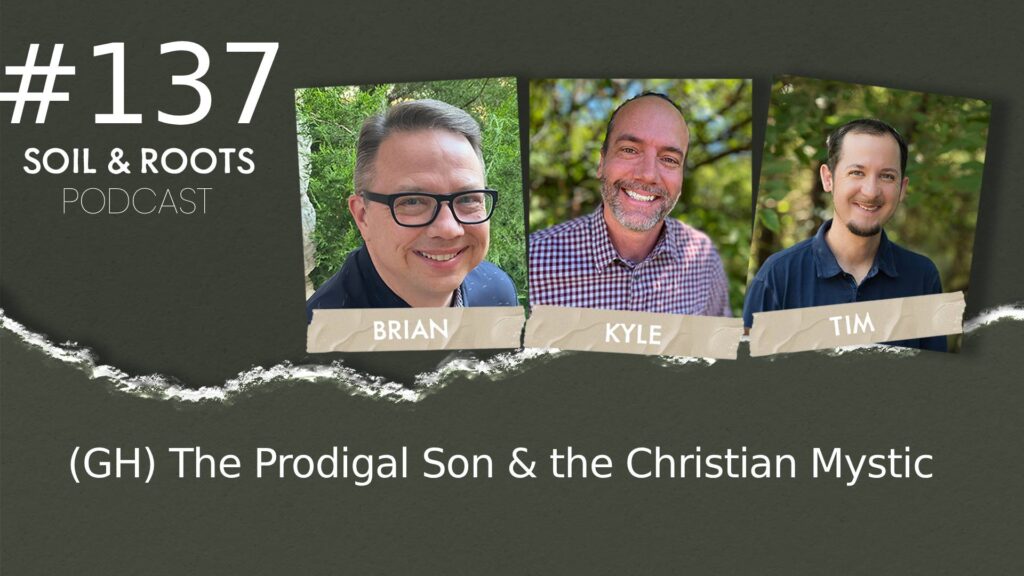


What if the abundant, with-God life Jesus describes is real… but rarely experienced?
In this episode, we explore one of the most famous parables ever told — the Prodigal Son — through a different lens.
What if the younger son’s transformation wasn’t primarily about repentance, but about vulnerability? What if he became what we might call a “Christian mystic” — someone formed by experiential union with the Father?
Join us online!
Web: soilandroots.org
Substack: https://substack.com/@soilandroots
YouTube: https://www.youtube.com/@soilandroots
Facebook: https://www.facebook.com/SoilAndRootsPodcast/
Instagram: https://www.instagram.com/soilandrootspodcast
Spotify: https://open.spotify.com/show/0kStr423THe8lYQoLwf3J3?si=c79a43c83fa84a4e
TRANSCRIPTION
Episode 136: The Prodigal Son and the Christian Mystic
Hello, and welcome to the Soil & Roots podcast, where we journey together into deep discipleship. I’m Brian Fisher, and this is Episode 136: The Prodigal Son and the Christian Mystic.
It’s great to be back with you as we continue our journey into Season 7, which is entitled Deep Calls to Deep.
That phrase only appears once in the Bible, and it comes from Ps 42:7:
Deep calls to deep
at the roar of your waterfalls;
all your waves and breakers
have swept over me.
You might wonder why I chose this phrase and verse as the theme of this season, because it isn’t a particularly peaceful passage. Waves and breakers sweeping over us don’t seem to connect well with what we’re calling The Good Life. Well, stay tuned, and we’ll see how those dots connect.
Our very first episode launched in May of 2022. It’s been about 4 years, and we are finally exploring the “how” question. How do we become people of depth? Harkening back to the book, The Critical Journey, how do we become Stage 6 followers of Jesus, people who naturally and unconsciously think like Jesus thinks, act as He acts, relate like He relates, and love like He loves? Doesn’t that sound amazing?
How do we become more attuned? To God, others, and ourselves? How do we become less anxious and fearful, more relationally secure, and more willing to give ourselves away, what some authors call “holy indifference”?
The Holy Spirit is, of course, the one who guides us into and through this journey. But as we’ve discussed, we need to intend to join Him.
We’ve talked at length about the obstacles to our discipleship, and that exploration has been worthwhile. Becoming increasingly aware of both the helpful and harmful ideas that form our cultures and our churches is essential in our quest for depth, and I hope it’s been helpful to you.
We’ve covered a ton of ground: The Great Omission, Christian fatalism, the impact of our families of origin and our stories, the negative aspects of Christian institutionalism, the downsides of Western culture and technology, a modern hyper-emphasis on instruction, and the harmful downplaying of relationships and experience.
Remember, modern Christianity still primarily functions from the Enlightenment idea that “I think, therefore I am.” But the Kingdom’s perspective is very different: I am loved, therefore I am.
Discipleship is not just about what we mentally accept. It is about who we are becoming. A life apprenticing with Jesus is primarily about the ongoing formation of our inner life.
A Quick Review
In Episode 134, I outlined the entire Soil & Roots journey in three phases or categories.
The first category is The Good Life. This is the type of inner life the Bible seems to invite everyone into. It’s a life of daily, intimate, secure relational attachment to God.
Verses abound describing this type of life:
John 15: Abide in me and I in you
John 14:23: We will come to them and make our home with them.
Matt 11: You will find rest for your souls
Philippians 4: The peace of God will guard your hearts and minds
John 17:3 – that we may know God and Jesus Christ
Romans 8: there is no condemnation
1 John 4: perfect love casts out fear
2 Corinthians 3:18 – we are being transformed from glory to glory
Acts 17: in him we live and move and have our being
Eph 3:17-19: know the love of Christ which surpasses knowledge
Listen to some of these key words: abiding, resting, home, peacefulness, knowing God intimately, no condemnation, the casting out of fear, transformed, living in Him, we know love beyond knowing.
The good life! The with-God life. A life characterized by love because we live in the experience of His love.
As we noted before, this type of life is also called Christian mysticism.
A Christian mystic is simply someone who is formed by an experiential union with God, in the same type of way that a husband and wife form each other experientially over time.
And we’ve concluded that Christian mysticism should actually be the norm for anyone who follows Jesus!
But is it?
What the Data Says
According to the Barna Group, among people who identify as Christian:
- 20% engage in daily prayer
- 10% report feeling “deeply connected to God.”
- 5-8% show indicators of integrated spiritual formation
Although not particularly scientific, I combined Barna with a few other research efforts, and estimate that:
- 20-25% of people who claim to follow Jesus believe in a relational God
- Around 15% experience God occasionally
- 5-8% live with a regular awareness of God’s presence
- Between 2-5% live something resembling this with-God life, or the Good life.
If this rough summary is even close to accurate, we can conclude that the New Testament assumes a way of life that only a small percentage of modern Christians actually experience.
That’s worth repeating: the teachings of Jesus and other writers point to a way of life that only a few of Jesus’ followers experience.
The data raises an obvious question: if the Bible promises an abundant, relationally secure, peace-infused life that exudes unity, wisdom, and love, why may we not be experiencing it?
One reason I’ve already mentioned briefly is that the vision for this type of life is rarely taught.
Remember, we remain in a version of Christianity that prioritizes getting saved and getting educated over inner formation. And we could spend an entire season exploring how the institutional church does or does not help us into these waters.
Back to Surrender
Yet there are additional, deeper reasons why so few of us live in the reality of the Good Life, and they center on our struggle to be vulnerable.
The Good life requires vulnerability, and vulnerability is formation-intensive rather than information-intensive. We live and operate from what we love and fear, not from what we intellectually affirm.
Remember our David Benner quote – “Genuine transformation requires vulnerability. It is not the fact of being loved unconditionally that is life-changing. It is the risky experience of allowing myself to be loved unconditionally.”
Yet, as we’ve admitted, we struggle to be vulnerable! To receive God’s unabashed, transformative, unconditional love is not as easy as we might assume.
Let’s explore a few reasons why vulnerability may be such an obstacle to us, even if we desperately long to live the Good Life.
Ok, to do this, I’m going to go way back into the archives and remind us of the concept of ideas.
An idea is a conclusion, assumption, or principle in which our hearts are rooted, but of which we are generally unaware. They are not so much intellectual agreements as they are experienced realities. If you’ve been around Soil & Roots for any length of time, you are very familiar with ideas.
Most of our ideas are formed through relationships and experience, particularly in our earlier years.
Remember, the name “Soil & Roots” centers around these ideas. Our hearts are our roots, and the soil is the systems of ideas in which our hearts are rooted. Our soil is the formative relationships and experiences in our lives, with God, others, ourselves, and creation and culture.
Way back when, I suggested to you that there are 6 Core Ideas that influence our hearts more than any other: identity, anthropology, value, power, purpose, and love.
In other words: who am I, what am I, what am I worth, what authority do I have, why am I here, and what do I truly desire? How our hearts (not our heads) answer these questions reveals where we truly are on our discipleship journeys.
These 6 Core Ideas are not normally processed consciously. Remember, our ideas are like our operating system – they work in the background, and we aren’t usually aware of them.
I know we’re getting deep here, but stay with me.
Four Obstacles to Receiving
I’m going to share four obstacles to receiving God’s love vulnerably and map them onto these core ideas.
1. The first obstacle to receiving God’s love with vulnerability is our need for control, which relates to the core idea of power. Who is really in charge?
2. The second obstacle is our avoidance of pain. This relates primarily to our ideas about anthropology – what does it mean to be human? We assume pain is something to eliminate or numb rather than a place where God meets us.
3. The third is the idea that I’m not worthy of receiving God’s love. I’m too broken for Him. These are internal messages of shame and relate primarily to our ideas of value.
4. The fourth obstacle is a mistrust of God’s character. I’m not sure God is actually safe or good. This maps primarily to ideas of identity. Who is God, really? And who am I to God, really?
Let me try to put some flesh on this.
Imagine a young child playing outside—running hard, completely free—when they trip and fall. It’s a real fall. Skin scraped. Maybe some blood. Definitely shaken.
A loving parent sees it happen and immediately moves toward the child. Arms open. Ready to help.
But instead of running toward the parent, the child hesitates. Maybe even pulls back.
And it’s not because the parent isn’t loving.
It’s because, in that moment, the crisis causes the child to function from her base operating system – from her core ideas.
If she stops—if she lets herself be held—the pain and fear will come rushing to the surface all at once, and they don’t yet know how to handle that.
There’s also that early sense of, “I want to do this myself.” Not necessarily rebellion—just self-protection.
And somewhere along the way, she’s already learned not to cry too much, not to make a scene, not to be a problem.
So, the child wipes away the tears and says, “I’m fine,” even though they’re clearly not.
What’s happening in that moment tells us a lot about why receiving God’s love in vulnerability is so difficult for us.
First, there’s control. For the child, it shows up as self-reliance— “I’ll handle this myself.”
For us, that instinct matures into the belief that safety comes from staying in charge. Vulnerability feels risky because it means relinquishing that grip. We typically don’t like it when our ideas of power are challenged.
Second, there’s pain avoidance. The child senses that accepting care will mean feeling everything at once. And so do we. We assume pain is something to outrun, numb, or explain away, rather than a place where God might actually meet us. Most of us have grown up in cultures where pain has been positioned as something universally bad and even unnatural. But, anthropologically speaking, pain is inevitable. It’s not that we face pain that defines us – it’s how we move through it.
Third, there’s shame and a sense of unworthiness. Even early on, the message is learned: don’t be a problem, don’t need too much, don’t fall apart. Over time, that becomes the quiet belief that we are too broken, too needy, or too much for love. We quietly question our value.
And finally, there’s mistrust of love itself. The child isn’t questioning whether the parent exists—but whether comfort will actually help or somehow make things worse. Many of us relate to God the same way. We believe He is real, even loving in theory, but we’re not sure He’s safe enough to entrust our hearts to.
So, we say, “I’m fine,” and remain guarded, missing the very love that could heal us.
And, at the risk of sounding like a broken record, we respond to God’s constant invitations like this…unconsciously. That is, until we do the hard work of uncovering our genuine ideas.
The Prodigal Son
We actually find these same four obstacles in perhaps the most famous parable of all time – the parable of the prodigal son. I won’t go through the entire story as I suspect you’re familiar with it.
But it does give a fascinating look at these four obstacles, how they are challenged by suffering, and how the younger son’s ideas change when he returns home. His father’s love transforms the son’s obstacles.
Very quickly:
At the beginning of the story, what are the son’s ideas about power? Well, he brazenly asks for his inheritance before his father dies, so it’s obvious he functions from the assumption that he has more authority than his dad.
What about anthropology? What does the son assume about pain? Chances are, when the story starts, he hasn’t dealt with too much of it. Or, if he has, he has been able to numb it at home.
How about value? To put it bluntly, he finds himself more valuable than his father or the rest of his family.
And identity? It’s clear he functions from the idea that he belongs to himself. He rejects his father and his family, perfectly happy to run his own life as he wishes.
But remember, God’s customary invitation to us to enter the Good Life, to live the with-God life, is suffering. What is the son’s response when he encounters pain?
He awakens! Or, in Soil & Roots lingo, he becomes more attuned to himself and to His Father. He becomes aware of his ideas.
What happens to his obstacles? Because he presses into the suffering, his four ideas change. His heart realizes he has very little power; he finds pain not something to numb but something to experience with others. His ideas of value do a 180. He no longer views himself as too valuable, but rather not valuable enough! And his idea of identity goes through a radical shift. He is willing to give up his sonship just to be back in communion with His father.
The most beautiful part of the story is, of course, the end, because the younger son actually shows us how to enter the Good Life. We watch him become a Christian mystic, if you will, someone who dwells in the experiential love of His Father.
The son comes home; his father sees him from a long way off and runs to meet and embrace him. The son begins his prepared, self-deprecating speech, but the father interrupts him and instead demands that the whole household throw a party. The father gives him valuable gifts and brings him back into the house, overjoyed that his son has returned.
What rarely gets discussed, however, is the son’s response once the father ignores his speech. What does the son do? Receives his father’s unconditional love with vulnerability.
Have you ever thought about how you would respond if you were the younger son and your father treated you like this?
I could imagine myself insisting that the father treat me as a servant, not a son. I may have insisted that I finish my speech, so sorry and sad that I had squandered my inheritance, so embarrassed by my behavior, that I would simply demand that I needed to earn my way back into the family. Either I would be his servant, or I wouldn’t come inside the house. Sounds honorable, doesn’t it?
I could refuse to go to the party, having concluded that I simply didn’t deserve the love of my father. I could conclude that I was once too good for Him and now, I’m too bad for Him.
Perhaps I would simply run away again – so overwhelmed by the father’s radical and surprising response that I just can’t take it – such forgiveness, such generosity is just too much.
But happily, that isn’t how the younger son responds. He stops talking, receives the Father’s embrace, and allows himself to be celebrated. He happily re-enters his father’s house, where his father is in loving control. He allows the father to heal his pain simply by being with him. He accepts the value his father bestows on him, and he rests in his identity as his son.
The younger son becomes a Christian mystic. He allows himself to be loved as his father intends, and the result is a secure relational attachment, transformed ideas of power, value, anthropology, and identity, and he vulnerably receives the somewhat reckless, prodigal love of his father.
Discipling the Unconscious Self
Someone recently asked me what was different about Soil & Roots. Why did we even exist when discipleship is such a ubiquitous term in modern Christianity?
Well, my first response is that we explore discipleship anthropology, not just theologically. The central question we ask here is: “How does one person become more like another person?” If discipleship is the journey to become more like Jesus from the inside out over time, how does that actually happen? The process of inner formation or character formation is an anthropological question.
That is tied to my second response. Soil & Roots explores what it means to disciple the unconscious self. If, in fact, we are governed and powered by ideas and desires that we normally don’t pay attention to…what if we did?
If the point is to naturally, organically, and effortlessly think, act, relate, and love more like Jesus over time, then that transformation needs to influence both our conscious and unconscious selves.
And as we’ve noted many times, the unconscious parts of our hearts are primarily shaped by relationships and experiences, not by intellectual arguments.
That is precisely what we find in the prodigal son. The son’s unconscious, inner life is not changed by arguments or facts. Those are essential to the Christian life, but they are not particularly formative. What transforms the son’s inner life is the relationship to and the experience of His Father.
And the son can experience His Father only when he surrenders in vulnerability to his extravagant love.
As it turns out, this type of vulnerability is not a one-time event. For most of us, it’s a way of life that we learn to experience over time.
Some key takeaways for today. Do we really believe that the Good Life is what God has for us? Or are we in the 95% of Christians who don’t experience a with-God life? Do we even want to be transformed into Christian mystics? That’s a challenging question.
How challenging is it for us to receive God’s love with vulnerability? Do we really want to surrender and give up our ideas of power, value, anthropology, and identity?
I’ve tried to make the case to you that becoming a deep disciple depends on our knowing both Jesus and ourselves better. I’m not sure I could make a better case for knowing ourselves than today’s episode. Perhaps the base reason why so many of us don’t experience the Good Life is that we’d rather not get to know either one of us.
As C.S. Lewis famously quipped:
“We are half-hearted creatures, fooling about with drink and sex and ambition when infinite joy is offered us, like an ignorant child who wants to go on making mud pies in a slum because he cannot imagine what is meant by the offer of a holiday at the sea. We are far too easily pleased.”
Thanks for being with me today.